
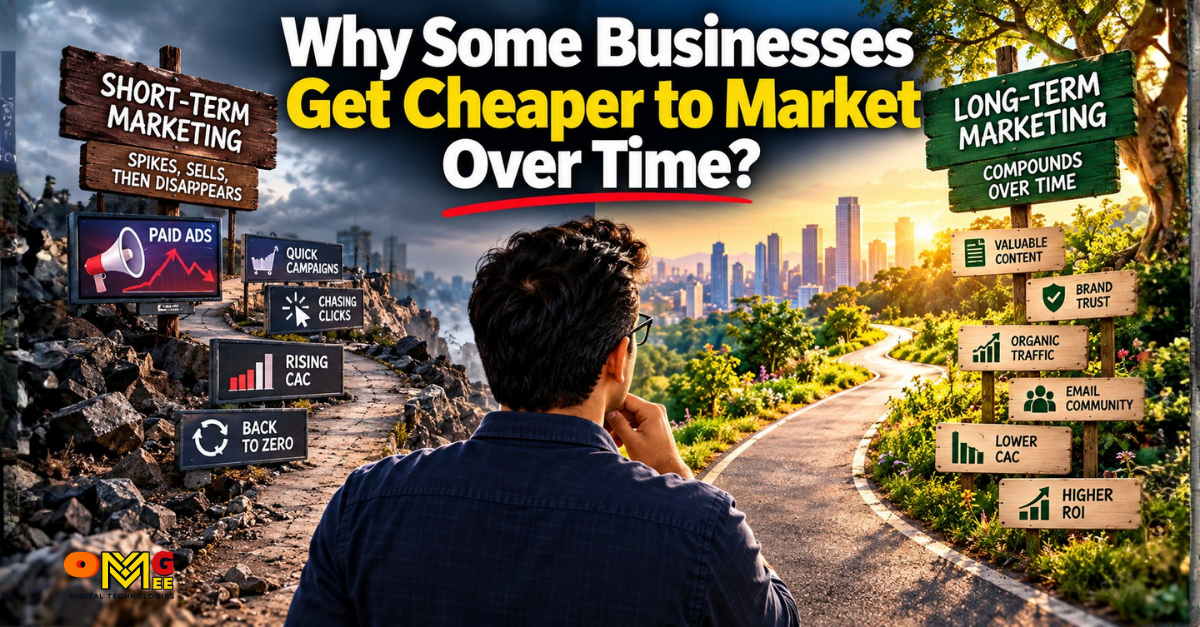
Discover why long-term marketing compounds into unstoppable growth while shortcuts fade. However, real data, a flywheel framework, and an Indian founder’s story are inside.


The Question Nobody Wants To Ask
In reality, the marketing campaign you launch today will probably be forgotten in six weeks.
Not because it was bad. Because that’s how short-term marketing works. Nevertheless, it spikes, it sells, and then it disappears. And then you’re back at zero, writing another ad, chasing another click, wondering why customer acquisition costs keep climbing every quarter.
So why do some brands seem to get cheaper to market over time, while others get more expensive? Why does one company’s fifth year of marketing outperform its first, while another burns cash on ads that stop working the moment the budget stops flowing?
Rather, the answer isn’t a secret algorithm or a bigger budget. It’s a mechanism — one that behavioral economists, ad-effectiveness researchers, and quietly successful founders have understood for decades but rarely explain in plain language. This piece breaks that mechanism apart, shows you the evidence behind it, and gives you a system you can start building this month, whether you run a two-person shop in Agra or a growth team in Bengaluru.

What “Long-Term Marketing” Actually Means
In contrast, long-term marketing should not be seen as a campaign type. It’s an operating philosophy: you invest in assets that continue producing value long after the invoice is paid, rather than renting attention that vanishes the second you stop paying for it.
Moreover, two ad-effectiveness researchers, Les Binet and Peter Field, spent years mining the IPA Effectiveness Databank to answer this question. Specifically, this finding—now a top marketing rule—states that the ideal budget is about 60% for brand-building and 40% for activation.
Indeed, that’s not an arbitrary number. Additionally, it reflects two fundamentally different mechanisms:
- Therefore, sales activation targets people already ready to buy. It’s fast, measurable, and fragile — the moment you stop spending, the effect disappears.
- Brand building grows the pool of future buyers who aren’t ready yet. It takes longer to show up in a dashboard, but it compounds, reduces price sensitivity, and makes every future activation campaign cheaper.
The Long and the Short of It: Binet & Field’s Framework Explained
Binet and Field’s research is also blunt about what happens when brands skip the long game: “there is no context in which short-term sales activation is the primary driver of growth — short-termism in marketing is unwise, always” [web:14]. That’s not a hedge. That’s one of the most rigorously tested conclusions in the discipline.

The Flywheel: How Small Wins Multiply Into Big Ones
Picture a heavy flywheel — the kind used in old factory machines. The first push barely moves it. The second push, applied in the same direction, moves it a little further. By the twentieth push, it’s spinning under its own momentum. Marketing works the same way, and understanding why changes how you plan.
Your website starts learning
A brand-new website is a guess dressed up as a strategy. You don’t yet know which headline converts, which page bounces, or which offer earns a reply. Every month of real visitor data replaces one assumption with one fact. After a few years, your site isn’t running on best practices copied from a blog — it’s running on evidence gathered from thousands of your own visitors. A competitor launching fresh can’t buy that; they have to earn it, one visit at a time.
Your content becomes a moat
Search engines and AI answer engines both reward depth and consistency over noise. Recent industry bench-marking shows that organizations with 400-plus indexed blog posts generate roughly 4.2 times as many leads as those with fewer than 100 [web:21], and businesses publishing 16 or more posts a month see about 4.5 times as many leads as infrequent publishers [web:20]. That gap isn’t about talent. It’s about time invested and never withdrawn.
Your database compounds quietly
Every campaign that doesn’t convert immediately still deposits value: an email address, a phone number, a retargeting pixel. A five-year-old list of qualified contacts is worth more than any single ad campaign, because you can nurture it indefinitely. Email marketing alone still returns between $10 and $36 for every $1 spent — the highest ROI of any common channel [web:18][web:28] — and every new subscriber makes that number even higher.
Your paid campaigns get smarter
Years of testing tell you exactly which audiences, offers, and creative angles drive revenue rather than vanity clicks. You’re not guessing anymore; you’re refining. That’s the quiet advantage nobody screenshots for LinkedIn.
The Numbers That Should Change Your Budget Meeting
If you need to justify a shift from short-term thinking to long-term investment in your next planning session, these figures do the arguing for you.
| Metric | Short-Term / Paid Focus | Long-Term / Content Focus |
|---|---|---|
| 3-year average ROI | Diminishes after spend stops | Up to 844% for content marketing |
| Cost per lead | Typically higher, rises over time | Content marketing costs 62% less than outbound |
| Lead volume | Flat without continuous spend | 3x more leads than outbound marketing |
| Breakeven point | Immediate but short-lived | 7–9 months, then compounds for years |
| Brand consistency payoff | N/A | Consistent brands see 56% market-share gain vs. 20% for inconsistent ones |
That last row deserves attention. A 2026 System1 and IPA analysis of the newest Databank campaigns found that the most visually and message-consistent brands — the top 20% — saw 75% report very large sales value gains versus just 40% for the least consistent brands, and the gap widened the longer they stayed consistent [web:5]. Consistency isn’t a nice-to-have. It’s a compounding multiplier.
Building Your Own Flywheel: A Practical Framework
Theory is easy to nod along to. Building the system is the hard part. Here’s a workable sequence, whether you’re a solo operator or leading a team.
Step 1: Pick assets that appreciate, not depreciate
Before green-lighting any campaign, ask one question: will this asset still work for me in three years, or will it disappear the day the budget runs out? A blog post, an email list, a YouTube tutorial, and a case study all appreciate. A boosted post with no landing page behind it depreciates the moment the ad account pauses.
Step 2: Publish on a rhythm you can sustain for years, not weeks
Consistency beats intensity. A weekly cadence you maintain for three years will outperform a daily cadence you abandon after six weeks. Momentum, once broken, has to be rebuilt from a near standstill.
Step 3: Instrument everything from day one
You cannot compound what you don’t measure. Track traffic sources, page-level conversion rates, email list growth, and cost per qualified lead on a monthly basis, even when the numbers are small. Those early data points become the evidence base that makes year-three decisions faster and cheaper than year-one guesses.
Step 4: Protect the 60/40 balance
Binet and Field’s own caveat matters here: the ratio isn’t iron law. For a brand-new business, it may lean closer to 70:30 in favor of brand-building reach; for an established leader defending share, it might shift toward 40:60 . B2B categories, where sales cycles run longer and buying committees are larger, tend to average closer to 46% brand and 54% activation [web:11]. The principle that survives every variation: never let activation spend alone carry your growth story.
Step 5: Let channels reinforce each other
A blog post that ranks well feeds email subscribers. Email subscribers become a warm retargeting audience. Retargeting data teaches your paid campaigns which messages convert. That feedback loop, running for years, is the actual “growth hack” — it just doesn’t fit in a 30-second reel.
Alt text: Marketing team in an Indian office collaborating around a flywheel growth diagram on a whiteboard.

What Happens When You Skip This
The opposite path is well documented, and it isn’t pretty. Effectiveness researchers analyzing the same IPA data found that as short-term campaigning increased industry-wide, overall advertising effectiveness steadily declined [web:9]. One marketing consultant summarized the pattern bluntly: most brands aren’t running the recommended 60/40 split — they’re running closer to 20/80 in favor of activation, and then wondering why cost-per-acquisition keeps climbing every year [web:10]. That’s not a coincidence. It’s the mathematically predictable result of spending down brand equity that nobody is replenishing.
Think of it like a well. Activation spend draws water out. Brand-building spend refills the aquifer. Draw without refilling long enough, and eventually the pump comes up dry — no matter how efficient your targeting gets.
A Story From Closer To Home
A small water-treatment equipment supplier outside Pune spent three years relying entirely on cold calling and a handful of paid ads on listing sites. Every festival season, the founder increased ad spend to hit quarterly targets, and every year the same ads cost more to deliver the same number of leads. In year four, on a colleague’s suggestion, the team began publishing short, plain-language articles answering the exact questions their site engineers were asked on every visit — things like STP maintenance schedules, compliance checklists, and energy-cost comparisons between treatment technologies.
Nothing changed for the first four months. By month nine, two of those articles were ranking on the first page for searches from procurement managers at mid-sized manufacturing plants. By the end of year one, organic inquiries accounted for nearly a third of new business, at a fraction of the cost of paid listings. The founder didn’t switch off paid ads. But for the first time, the business wasn’t entirely dependent on them, and every new article made the next one easier to write, because the team finally understood which questions actually moved a buyer toward a decision.
That’s the flywheel in miniature: unglamorous, slow to start, and eventually the reason the business stopped feeling fragile.
The Authenticity Arc: Why Proof Beats Polish
There’s a reason long-term marketing content outperforms polished short-term campaigns in trust metrics, and it maps to three tiers of content credibility.
- Principles — general advice and insights. Easy to produce, easy to copy, and the least persuasive because anyone can repeat them.
- Process — showing your actual workflow, decisions, and mistakes. Harder to fake, because it requires you to have actually done the work.
- Proof — verifiable results, real numbers, real timelines, real names (or plausible anonymized ones) attached to outcomes. Nearly impossible to fabricate convincingly, and the tier readers trust most.
Most brands publish only principles. The ones that pull ahead publish proof — case studies with real timeframes, dashboards with real (even unflattering) numbers, and stories that admit the slow first year before the good third year. If you want your content to outcompete louder, better-funded rivals, climb this ladder deliberately: start where you are with principles, document your process honestly, and let proof accumulate naturally as your own results come in.


Where This Is Heading Next
Two shifts are already reshaping how long-term marketing assets get discovered. First, AI-powered answer engines are increasingly citing established, consistently published content over freshly published pages — meaning older, well-maintained content libraries now carry a discoverability advantage they didn’t have five years ago. Second, short-form video has emerged as the highest-ROI content format cited by marketers in 2026, ahead of long-form video and live streaming, which means the flywheel model now needs a video component, not just written content, to stay competitive.
Neither trend replaces the underlying principle. Both simply give patient marketers new pipes through which the same compounding water flows.

The Takeaway That Actually Matters
Marketing rewards patience the same way compound interest rewards early investors: unevenly, invisibly at first, and then unmistakably. The brands winning in year five aren’t the ones that found a secret channel. They’re the ones that kept showing up in year one, when nothing seemed to be working, and let the evidence — not the impatience — decide what to do next.
90 Content Marketing Statistics for 2026 (Data + Sources)
Start smaller than feels impressive. Publish something useful this week. Track it honestly. Do it again next week. In three years, you won’t be running a bigger version of the same campaign — you’ll be running a different kind of business, one where marketing is an asset rather than an expense.
As a result, what’s the one long-term marketing asset you stopped investing in too early? Tell us in the comments — and if this reframed how you think about your budget, share it with the person on your team who keeps asking for “one more quick-win campaign.
Have you seen the flywheel effect play out in your own business? Drop your before-and-after numbers in the comments — real data helps everyone reading this.

Leave a Reply