
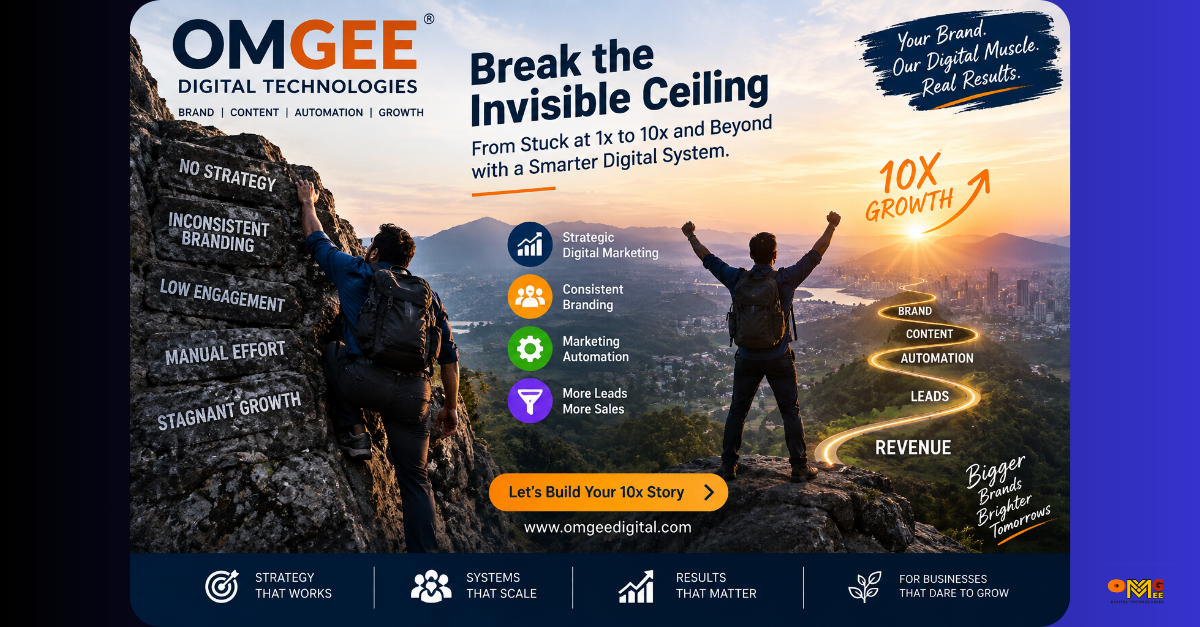

Additionally, 90% of businesses that cross their first million in revenue never reach 10 million. Not because the product got worse. Not because customers disappeared. Because something invisible took over — a ceiling nobody budgeted for, planned around, or even knew to look for.
If your growth chart looks like a mountain that suddenly became a plateau, you’re not imagining it, and you’re not alone. Indeed, this is one of the most common — and most misdiagnosed — problems in business today.
The Wall Nobody Warns You About
Here’s what actually happens inside a stalled business, according to a wide-reaching study of leaders running $1M+ companies: 78% say hitting 10x growth demands major changes to sales and marketing, not minor tweaks [web:1]. Even more revealing, 61% admit they themselves are the bottleneck in their own sales and marketing decisions.
Additionally, read that again. The people running the business often constrain growth, not because they’re incapable, but because the systems around them do not scale past a certain point. However, a founder who personally approved every social post, ad, and brand decision at $200K can’t scale to $1.5M. It worked once. It can’t work forever.
Nearly half of these stalled leaders point to internal operational limits — not market conditions — as the real barrier . The market isn’t closing the door. The business’s own machinery is.

The Organic Growth Illusion
Somewhere in the last decade, a comforting myth took hold: post consistently, stay authentic, and the algorithm will notice you. Nevertheless, growth will simply happen.
It’s a good story. It’s also increasingly untrue.
Look at what’s actually occurring across social platforms and search right now:
- 83% of marketers say capturing audience attention online is harder than it was just one year ago.
- 61% name generating traffic and leads as their single toughest challenge.
- The average small business website converts only 2-5% of its visitors.
- 68% of small businesses have never built an actual sales funnel. Half don’t even have a written marketing plan.
Organic reach isn’t worthless — it’s just misunderstood. It’s a discovery mechanism, not a growth engine. Businesses that treat “posting content” as their entire strategy are essentially pouring water into a house with no roof: the effort goes somewhere, but nothing structured is there to catch it and turn it into compounding results.
The real problem was never a lack of hustle. It was the absence of a system holding that hustle together.
Automated Branding: The Quiet 2.4x Advantage
If organic effort alone is the myth, automated branding is the antidote — and the numbers behind it are hard to argue with.
Brands that show up consistently — same voice, same visuals, same message — across every channel see measurable financial upside. Independent research converges on a strikingly tight range: a 23-33% revenue increase directly tied to brand consistency. Push further, and businesses scoring high on consistency grow at 2.4 times the rate of their inconsistent competitors .

Here’s the catch: most small businesses know this and still can’t execute it. 63% of marketers admit they struggle to keep content consistent across channels, and 46% say their output doesn’t even match their own brand guidelines [web:4]. This isn’t a talent gap. It’s a bandwidth gap. One founder, or one exhausted marketing hire, cannot manually police tone, visuals, and message across every post, every platform, every single day, indefinitely.
This is exactly where automation flips the equation. When branding becomes systemized — templated visual identity, locked-in voice guardrails, automated content workflows, centralized brand governance — output scales without quality falling apart. Centralized brand systems deliver a 2.7x lift in content velocity while reducing duplication and drift. And digitally engaged businesses overall are 50% more likely to grow revenue and 8 times more likely to create new jobs than businesses without functioning digital infrastructure.
This is the exact insight OMGEE Digital Technologies built its 360° strategy around: branding isn’t a creative side project. It’s an operating system. When your visual identity, messaging, content cadence, and customer touchpoints are automated and unified, every marketing dollar compounds rather than leaking through the cracks.
“One Great Whitepaper Can Win You the B2B Content War”
Why You Can’t See Your Own Ceiling
The reason this bottleneck is so hard to spot from the inside is that it never looks like a marketing problem. It looks like a “we just need to try harder” problem. In the same growth-stall research, 59% of leaders admitted they’d mistaken busyness for actual progress [web:1].
So they add an ad budget. They hire another freelancer. They post more often. And the ceiling doesn’t budge — because the constraint was never effort. It was the missing connective tissue between brand, content, funnel, and conversion.
Only half of the leaders in that study believed their current team could support 10x growth as it stands today. That’s not a motivation problem. That’s a structural one — and structural problems don’t get solved by working harder inside the same broken frame. They are solved by rebuilding the frame.

A Short, True Story From Gurugram
A small facilities-services company in Gurugram had spent three years building a loyal client base through word of mouth and steady, honest work. Revenue crossed a comfortable plateau and stayed there — quarter after quarter, almost to the rupee. The owner assumed it was market saturation. Everyone in the industry told him the same thing: “This sector just doesn’t scale past a point.”
A closer look told a different story. The business had no consistent brand identity across its proposals, no digital presence beyond a static website from years earlier, and every new client came from referrals — a channel that’s inherently capped. There was no system turning satisfied clients into a repeatable acquisition engine; there was only luck, repeated.
Once branding and outreach were rebuilt as a connected system — a consistent identity across every proposal and touchpoint, a structured content presence, and a simple funnel to capture inbound interest rather than relying solely on referrals — new leads began arriving from channels that had never existed before. The lesson wasn’t about spending more. It was about building the machinery that referrals alone could never provide.
The Takeaway That Changes Everything
If your growth has flattened despite doing “everything right,” the problem isn’t your product, your effort, or your market. It’s an invisible ceiling built from fragmented branding and marketing, never designed to run without you personally holding it together.
Fixing it isn’t about working harder. It’s about building a system that works without requiring constant manual effort.


Leave a Reply