
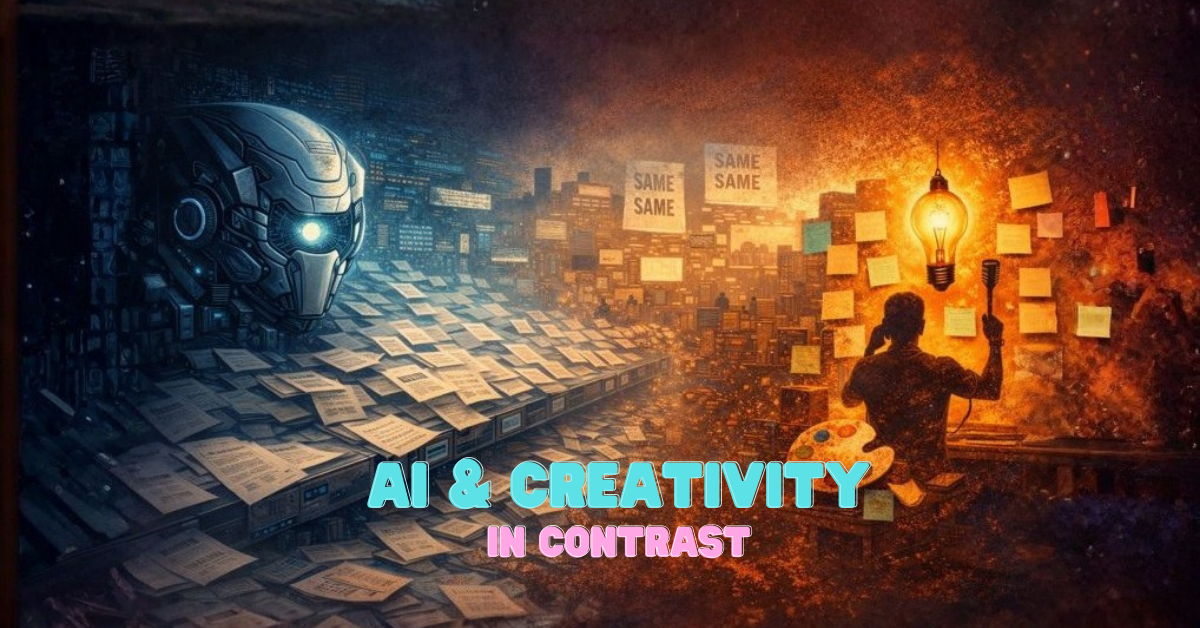
The Paradox of Abundance: When More Content Creates Less Creativity


As we approach the end of 2025, experts predicted nearly 90% of online content would be AI-generated, suggesting that anyone can create and participate.
But research reveals a darker paradox.
While individuals become more productive using AI, collective originality declines. One person produces more—but the ecosystem becomes flatter, narrower, and more repetitive.
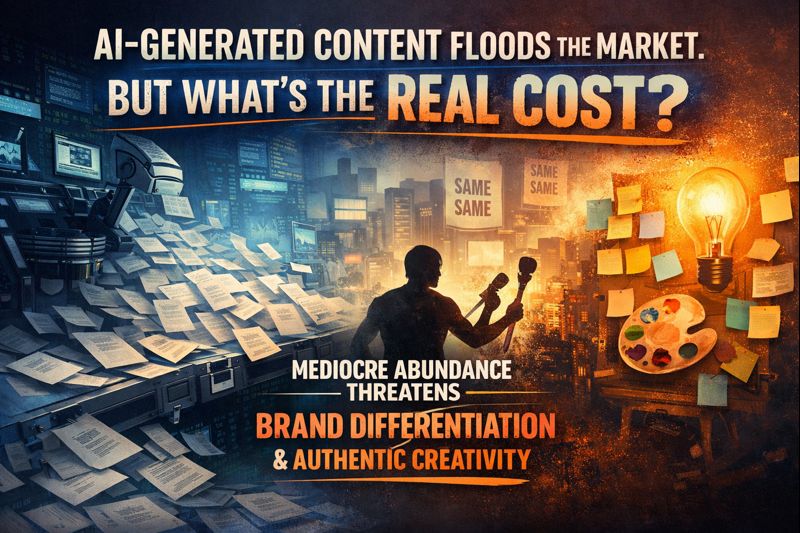
“When millions of marketers use the same AI tools with similar prompts, they all get variations of the same patterns back. Everyone optimizes toward the statistical center. The edges disappear. The distinctive voices blend into background noise. This isn’t the democratization of creativity—it’s the systematization of mediocrity.”
— Analysis of AI training data effects on creative output
Why?
Because AI systems learn from what already exists. They optimize for what worked before. When millions of people prompt the same tools with similar instructions, the outputs converge toward the same statistical middle.
The edges disappear.
The strange, risky, uncomfortable ideas fade.
What remains is volume—without voice.
This is how we get maximum output with minimum originality.
The Mediocrity Trap: When “Good Enough” Becomes the Standard


In the past, quality mattered because it was scarce.
Good writing, thoughtful design, and meaningful storytelling required time, skill, and investment. Poor quality carried consequences.
AI has inverted this equation.
Today, acceptable content is cheap, fast, and endless. When adequacy costs almost nothing, excellence starts to look economically irrational.
Research shows:
- 65% of marketers believe human content is higher quality
- Yet AI content keeps getting published because it’s 4–5× cheaper
- Many audiences can’t tell the difference at first glance—but they feel it over time pasted
The result is a cultural shift where “fine” replaces “memorable,” and forgettable becomes normal.
Why AI-Generated Content All Sounds the Same


READ MORE 👇
My AI Writing Process: How I Use Different Tools at Each Stage
Scroll through LinkedIn or marketing blogs today and patterns leap out:
- Identical hooks
- Familiar emotional beats
- Predictable conclusions
Everything is polished. Almost nothing is distinctive.
This sameness isn’t accidental. It’s structural.
Root causes include:
- Training on already-optimized, algorithm-friendly content
- Convergence toward statistical averages
- Lack of taste, judgment, and cultural risk assessment
AI doesn’t know when something is interesting. It only knows when something is likely.
And brands pay the price.
Only a small minority of consumers believe AI produces better brand communication—and nearly half insist humans should always review AI content before it goes live.
Efficiency wins.
Differentiation loses.
The Authenticity Rebellion: Why Audiences Are Pushing Back


Here’s the twist: audiences don’t want perfect mediocrity.
They’re rejecting it.
Across platforms, raw, imperfect, human content consistently outperforms over-produced, generic messaging. A shaky phone video with genuine emotion beats a flawless script with no soul.
This explains why brands that embrace humor, spontaneity, and human quirks stand out—because these qualities resist automation.
Authenticity creates economic value because it:
- Feels intentional
- Signals care
- Builds trust
Ironically, many companies save time using AI only to lose it again during reviews, edits, and brand repairs—erasing the promised efficiency gains.
AI Works Best as a Multiplier — Not a Mind


Research is clear:
AI boosts productivity most for average tasks and early drafts—but can reduce performance for experts when it replaces judgment.
The winning model isn’t automation.
It’s augmentation.
High-performing teams use AI for:
- Research
- Outlining
- Structural drafts
Humans remain responsible for:
- Voice
- Strategy
- Emotional intelligence
- Final judgment
This hybrid approach consistently outperforms AI-only systems—saving time without sacrificing meaning.
When 90% of Content Is AI-Generated, What’s Left?


If AI content becomes the dominant input for future AI models, we risk a feedback loop where mediocrity trains mediocrity.
This “AI-formization” shows up everywhere:
- Visual art converges into familiar styles
- Stories recycle the same plot structures
- Brand voices blur into indistinguishability
When everything sounds professional, nothing sounds personal.
And search engines are responding.
Google’s 2025 quality updates explicitly penalize content that is mass-generated, low-effort, and lacking originality—confirming what audiences already sense: volume without value is a liability.
The Future Is Stratified, Not Automated
We’re not heading toward a world where AI replaces creativity.
We’re heading toward one where creativity becomes scarce and premium.
- Bottom tier: Infinite, cheap, forgettable content
- Middle tier: Hybrid teams struggling with consistency
- Top tier: Authentically human creators commanding trust, attention, and loyalty
In a sea of sameness, distinctiveness becomes the advantage.
“The most successful teams don’t ask ‘How do we replace humans with AI?’ They ask ‘Where does this tool solve real problems versus where does it create the illusion of efficiency while degrading output quality?’ The answer separates brands that thrive from those drowning in adequate mediocrity.”
— Strategic insight from hybrid workflow research
Final Thought: Scale or Meaning — You Can’t Optimize for Both
Generative AI offers abundance.
Excellence demands intention.
The danger isn’t that humans will stop creating—it’s that organizations will stop investing in creativity because mediocrity no longer carries immediate penalties.
But history is clear: when everything becomes easy, what’s rare becomes valuable.
In a world flooded with “good enough,”
human judgment, taste, and courage become the ultimate differentiators.
The real question isn’t whether AI will transform creativity.
It’s whether we’ll protect what makes creativity worth having.


Are you trapped in the mediocrity paradox? Are you producing more content while your brand becomes increasingly indistinguishable? Join thousands of creative professionals reshaping their strategies to stand apart in an ocean of AI-generated sameness. Share your biggest challenge in the comments—are you struggling with authenticity, quality control, or brand differentiation in the AI era? Subscribe for the next piece in this series where we explore actionable frameworks for building distinctive creative strategies that command premium value. Let’s transform mediocrity into excellence together.
Conclusion: The Choice Between Scale and Meaning
Generative AI in 2025 presents a clear but unstated choice: we can have abundance or we can have excellence, but the market economics are pushing us toward choosing abundance. The real threat to creativity isn’t replacement—it’s suffocation under the weight of normalized mediocrity.
The homogenization isn’t inevitable. It’s a choice embedded in business models, incentive structures, and what we choose to measure and reward. Companies, creators, and individuals that recognize this choice and deliberately opt for distinctiveness, authenticity, and human-centered judgment will find themselves increasingly valuable precisely because they’re rare.
The future isn’t “AI vs. Human Creativity.” It’s “Mediocrity at Scale vs. Excellence Authenticated by Human Judgment.” The organizations that win will be those that understand AI’s actual utility—as a force multiplier for routine work—while protecting the human judgment, taste, and originality that generate meaning and competitive advantage.
The question isn’t whether AI will transform creativity. It’s whether we’ll let the economic incentives toward mediocrity override our commitment to excellence.
ChatGPT Unleashed: A Masterclass in Remote Productivity
Unlock the power of ChatGPT with our immersive masterclass! In this comprehensive guide, ChatGPT takes the lead, offering expert insights to revolutionize your remote work experience. Dive deep into advanced techniques, productivity hacks, and personalized strategies tailored to your unique workflow. From efficient time management to staying focused in a virtual environment, ChatGPT becomes your virtual productivity ally.
