
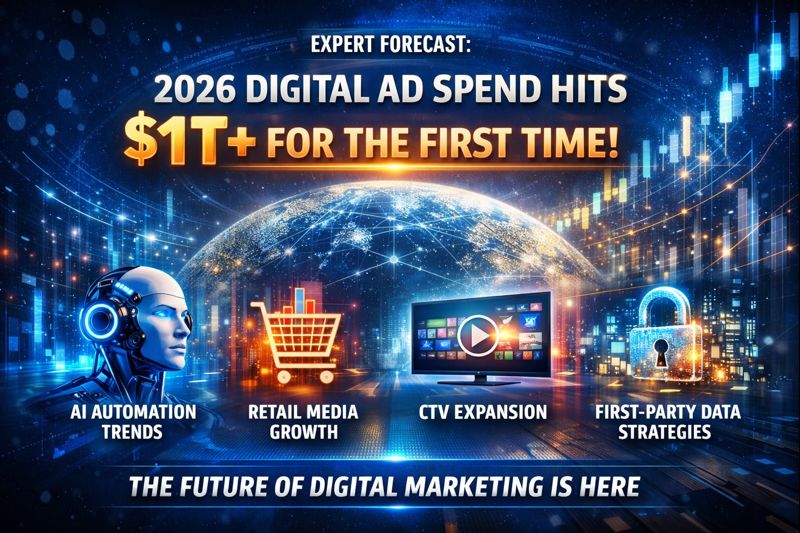
For the first time in advertising history, global digital ad spend is projected to surpass $1 trillion in 2026—a watershed moment that signals far more than just budgetary growth. This milestone marks the entrance into what industry experts call the “Algorithmic Era,” where artificial intelligence, autonomous systems, and privacy-first technologies fundamentally restructure how brands reach consumers. The digital advertising landscape isn’t simply expanding; it’s transforming at an unprecedented pace, leaving those unprepared to navigate these shifts at a significant competitive disadvantage.

This visual captures the shift from manual media buying to intelligent orchestration. A marketer sets the budget, while AI agents continuously optimize bids, audiences, and creatives across search, social, video, and CTV in real time. The result is faster decision-making, reduced waste, and measurable revenue uplift—typically 20–30%—showing how AI is becoming the operating system of modern digital advertising.
The $1 Trillion Milestone: More Than Numbers
Global advertising expenditure is forecast to reach $1.04 trillion in 2026, representing a 5.1% increase from 2025, according to Dentsu’s latest Global Ad Spend Forecasts. While this growth rate appears modest compared to recent years, the implications are extraordinary. For the first time in recorded advertising history, the industry has broken through the trillion-dollar ceiling—a testament to the staying power of digital media despite persistent macroeconomic uncertainty, geopolitical tensions, and policy risks.
This remarkable resilience stems from structural advantages built into modern digital advertising. Closed-loop measurement systems now enable brands to directly connect ad exposure to purchase behavior. First-party data collection has matured from experimental tactic to operational requirement. Artificial intelligence has graduated from buzzword to implementation imperative. Together, these forces create a powerful economic engine that outpaces GDP growth and justifies continued investment even when broader economic conditions appear uncertain.
The U.S. market alone is forecast to grow 5.0% in 2026, reaching $234.7 billion, while India is the world’s fastest-growing major advertising market, expanding 8.6%. This geographic diversification indicates that the digital transformation isn’t confined to mature Western markets—emerging economies are adopting advanced advertising technologies at accelerated rates, creating new opportunities for global platforms and regional specialists alike.
The AI Takeover: 71.6% of All Advertising Spend Will Be Algorithmic by 2026
The most consequential shift happening in 2026 isn’t visible to consumers—it’s happening inside campaign management systems where artificial intelligence increasingly makes critical decisions about budget allocation, audience targeting, creative optimization, and performance measurement.
By 2026, algorithmic systems will control 71.6% of global advertising spend, rising to 76% by 2028. This represents a complete inversion of the advertising industry’s traditional operating model. For a century, human strategists directed marketing campaigns. In 2026, machines will direct the majority of advertising dollars, with human expertise repositioned as oversight rather than execution.
This transformation divides into several distinct waves. First, autonomous AI agents are replacing semi-automated platforms that required human configuration. Unlike legacy systems where marketers set budgets, define audiences, and select creatives (with optimization adjusting within guardrails), new agentic AI systems generate creative assets from scratch, identify optimal audiences through real-time analysis, reallocate budgets dynamically, and present human insights for strategic validation rather than tactical approval.
Meta’s commitment to deliver “fully automated ads by end of 2026” exemplifies this trajectory. Brands will submit product images and budget targets; Meta’s AI will generate complete campaigns including photography, video, text variations, and audience recommendations. The system handles creative production, targeting, and optimization with minimal human intervention. This democratizes sophisticated advertising capabilities that previously required large in-house teams or expensive agency support.
Second, predictive analytics and campaign forecasting enable AI to anticipate performance before campaigns launch. Rather than reactive optimization based on real-time results, next-generation systems forecast conversions, customer lifetime value, and incremental revenue impact before spending a single dollar. This capability allows marketers to make smarter budget allocation decisions upfront while reducing wasted spend on underperforming tactics.
Third, autonomous programmatic buying is expanding beyond display to encompass all digital channels. By 2026, programmatic methods will account for 90% of digital display ad spending and growing portions of video, audio, and emerging formats. This automation isn’t merely making individual ad buys more efficient—it’s fundamentally changing demand aggregation, supply optimization, and pricing dynamics across the open internet.
The Intelligence Advantage
Organizations that embrace hybrid intelligence—combining human strategic thinking with AI execution capabilities—will capture a disproportionate share of advertising value in 2026. This isn’t about replacing marketers with machines. Instead, it’s about freeing human expertise from tactical execution so teams can focus on strategic insight, creative direction, and performance interpretation.
Agencies and consultancies that position themselves as AI-augmented rather than AI-replaced will thrive. Publishers that build proprietary AI models around their audience data will command premium pricing. Brands that treat AI as amplification rather than threat will achieve superior ROI.
Retail Media: The Channel That’s Finally Becoming a True Business
Retail media networks are projected to grow 25% in 2026, reaching $30.36 billion in India alone, while globally retail media is overtaking linear television for the first time. This seismic shift reflects a fundamental resolution to marketing’s oldest measurement problem: proof of impact.
For decades, CPG brands allocated budgets across channels without clear visibility into which tactics actually drove incremental sales. Television advertising provided brand lift but lacked transaction linkage. Digital provided clickthroughs but didn’t prove offline impact. Retail media solves both problems simultaneously—brands can see exactly which creative drove which purchases at which price points.
Retail media is reshaping digital advertising by turning first-party shopper data into measurable growth. With ads placed directly on product and search pages, every step—from view to add-to-cart to purchase—is tracked in a closed loop. This clarity on attribution and ROAS is why retail media is now the fastest-growing channel in digital marketing.

Why Retail Media Matters in 2026
The retail media explosion stems from three converging forces. First, retailers own first-party shopper data that captures actual purchasing behavior across product categories. This data is exponentially more valuable than third-party behavioral signals because it represents intent (purchase history) rather than inference (browsing patterns).
Second, closed-loop measurement connects advertising exposures directly to sales through unique customer identifiers. When a customer clicks a retail media ad for Brand X, and subsequently purchases Brand X at the same retailer, the connection is mathematically inevitable. No attribution modeling required. No probabilistic inference. Pure cause-and-effect.
Third, shared economic interest aligns retailers and brands. Retailers earn commission on advertising spend. Brands earn incremental sales. Both parties share data to demonstrate ROI, creating a virtuous cycle of reinvestment and optimization. This contrasts sharply with traditional media, where publishers and advertisers maintain adversarial relationships around pricing and measurement.
Specific implementations vary. Amazon’s advertising business generates estimated annual revenue of $36.9 billion through product-targeted ads that appear during shopping sessions. Walmart’s retail media network reaches 100 million+ shoppers monthly with comparable targeting capabilities. International retailers like Carrefour are building their own networks using data clean rooms to enable advertiser collaboration without directly sharing sensitive customer information.
The trajectory is unmistakable: retail media will capture an estimated 15% of India’s total advertising revenue by 2026 and similar percentages in other mature markets. CPG brands are reallocating trade promotions and traditional media budgets into retail media networks because attribution is unambiguous and ROI is demonstrable.
Connected TV: The Premium Format That’s Finally Affordable
Connected TV (CTV) advertising spending is projected to reach $44.7 billion globally in 2026, accounting for approximately 20% of U.S. media consumption despite only 10% of U.S. television viewing a decade ago. This explosive growth reflects structural change in how consumers access video content and how advertisers reach target audiences on premium inventory.
CTV encompasses any video content delivered through internet-connected devices: smart TVs, tablets, phones, and streaming devices. Unlike linear television, which offers broad demographic appeal and passive audience targeting, CTV enables precise behavioral, demographic, and psychographic targeting while maintaining the production quality and engagement levels of premium content.
The CTV Advantage for 2026
Three factors accelerate CTV adoption in 2026. First, cord-cutting accelerated post-pandemic with no reversal. Traditional linear television viewership declined 13% in 2024 alone, with further erosion expected. Simultaneously, streaming service adoption reaches saturation in developed markets, with consumers managing subscriptions across multiple platforms. Ad-supported tiers launch across Netflix, Max, Disney+, and Amazon Prime Video, creating premium CTV inventory without requiring new content production.
Second, programmatic innovation brought CTV to small and mid-market advertisers. Early CTV campaigns required direct deals with publishers, significant minimum spend, and sophisticated media buying expertise. By 2026, platforms like MNTN, StackAdapt, and others will have democratized access to CTV through self-serve interfaces similar to Google Ads and Facebook Ads Manager. This lowers barriers to entry and significantly expands the addressable market.
Third, measurement and attribution matured for CTV. Early concerns about cross-device tracking, fraud detection, and accurate conversion attribution have been substantially addressed. Data clean rooms enable advertisers to link CTV exposures to actual online and offline purchases without directly sharing sensitive customer data with publishers.
Geographic variation is notable. In the U.S., CTV spending reaches $44.7 billion in 2026 per conservative projections, with some analysts predicting higher given acceleration trends. International markets display even faster growth rates, with CTV still representing single-digit percentages of television advertising spend in many regions.
Programmatic Advertising: Growth Through Consolidation
Programmatic advertising is forecast to grow 4.4% in 2026, reaching 74% of open internet ad revenues, per Madison & Wall’s latest analysis. This growth rate, while positive, represents significant deceleration from historical trends. The slowdown doesn’t signal weakness—it reflects consolidation toward concentrated players with competitive advantages in data, measurement, and AI capabilities.
Madison & Wall’s analysis identifies fundamental restructuring of programmatic markets:
On the sell-side, publishers face unprecedented margin pressure. Programmatic revenues tied to digital platforms and publishers are expected to decline slightly as advertisers concentrate budgets toward large-scale platforms (Google, Amazon, Meta) that offer superior targeting, measurement, and creative optimization.
On the demand side, agencies increasingly build direct relationships with large publishers and retail platforms rather than routing all programmatic buying through external DSPs. This “disintermediation” trend reduces friction and enables tighter feedback loops between campaign execution and business results.
On open internet dynamics, ongoing conflict between buy-side and sell-side players around transaction IDs, auction mechanics, and data governance creates structural headwinds. What once appeared to be technical discussions about wrapper standards and auction architecture has escalated into power struggles over who controls open internet infrastructure. This uncertainty depresses investment in open internet technologies while encouraging migration toward walled gardens.
The practical implication: programmatic growth is driven primarily by a shift in buying methods rather than the expansion of overall spend. Publishers consolidate to smaller preferred networks. Advertisers concentrate budgets toward closed platforms with first-party data advantages. Independent ad tech companies face margin compression unless they deliver highly specialized capabilities.
The First-Party Data Revolution: Necessity Masquerading as Opportunity
While Google delayed third-party cookie deprecation in July 2024, allowing Chrome users to continue blocking them through settings rather than forcing deprecation, the strategic shift toward first-party data collection is irreversible. Privacy regulation, consumer expectations, and superior targeting capabilities when using first-party data create powerful incentives independent of browser-level cookie changes.
First-party data—information collected directly from consumers with explicit consent and awareness—offers three critical advantages in 2026 and beyond:
First, superior precision. When consumers knowingly provide information through account creation, preference centers, surveys, and purchase history, the data reflects genuine intent rather than behavioral inference. A consumer who explicitly indicates interest in outdoor equipment is more valuable than a consumer whose browsing history suggests possible interest.
Second, legal protection. First-party data collected with consent complies with GDPR, CCPA, and emerging privacy regulations across jurisdictions. As regulatory enforcement intensifies and penalties increase (the European Commission issued €120 million fines to X under the Digital Services Act in 2024), first-party data strategies become an operational necessity rather than an optional optimization.
Third, competitive advantage. Unlike third-party data available to all competitors through shared data brokers, first-party data collection creates a defensible competitive moat. Retailers with superior customer relationships accumulate proprietary insights that competitors cannot access, enabling superior targeting and personalization.
Implementation requires substantial investment in customer relationship infrastructure. Brands must build preference centers, incentivize email signup and app downloads, establish loyalty programs, and invest in email marketing platforms and customer data infrastructure. Small and mid-market businesses face particular challenges given the technical and financial requirements.
However, the return justifies the investment. Research from multiple sources indicates that first-party data effectiveness equals or exceeds third-party data performance when implemented comprehensively. Organizations that invested early in first-party data collection gained a significant competitive advantage in 2025 and 2026 as third-party data sources became less reliable and more expensive.
Data Clean Rooms: Privacy-Preserving Collaboration
Data clean rooms emerged as essential infrastructure in 2026, enabling retailers, brands, and agencies to collaborate on audience insights without directly sharing sensitive customer information. These technologies address the fundamental tension between the collaborative benefits of data sharing and privacy requirements that prohibit such sharing.
A data clean room operates in isolated cloud environments where parties upload their proprietary datasets. Queries against pooled data execute without any party seeing raw customer-level records. Results returned show only aggregated insights and statistical patterns, never individual customer identities or transaction details.
Implementation benefits are significant. Retailers and brands can identify audience segments, measure campaign effectiveness, and optimize targeting without either party seeing the other’s customer lists. This enables sophisticated analysis that neither party could accomplish alone while maintaining strict data privacy compliance.
For example, Carrefour partnered with LiveRamp to analyze consumer purchasing patterns across categories without creating data leakage risks. The analysis revealed how customer needs evolve—diaper purchases today predict formula needs tomorrow—enabling predictive targeting. This insight drove incremental sales without requiring direct exchange of customer data.

Data clean rooms are becoming the trusted bridge between brands, retailers, and publishers. By sharing anonymized data in a secure, privacy-compliant environment, marketers can unlock insights into audience overlap, measure true incremental lift, and build optimized media plans—without exposing sensitive customer information.
By 2026, data clean room adoption will accelerate as technical barriers decrease and regulatory requirements increase. Organizations that delay investing in these capabilities face mounting risks around data privacy while losing competitive advantage from collaborative intelligence.
Regional Variations: Asia-Pacific Acceleration
While global advertising grows 5.1% in 2026, regional variations are substantial. India emerges as the world’s fastest-growing major advertising market, growing 8.6%, with expectations for sustained acceleration through 2028.
Several factors drive India’s exceptional performance. First, digital penetration continues expanding rapidly. With 666+ million active internet users and rapidly growing smartphone adoption, the addressable audience for digital advertising continues to grow. Short-form video consumption on platforms like Instagram, YouTube Shorts, and emerging Indian platforms like Josh is driving growth in video advertising.
Second, retail media is experiencing explosive adoption in India. E-commerce platforms like Amazon India and Flipkart launch advertising networks, while traditional retailers invest in digital media capabilities. Retail press in India is forecast to reach ₹30,360 crore ($3.4 billion USD) by 2026, representing 15% of total advertising revenue.
Third, marquee events accelerate spending. The 2026 ICC Men’s T20 Cricket World Cup, IPL 2026, and other sporting events drive media investments from both Indian advertisers and international brands seeking to reach Indian consumers.
Other Asia-Pacific markets display similar dynamics, though India’s growth rate outpaces peers. China grows 4.2% despite government regulatory pressure and shifting consumer behavior toward value-focused consumption. Other regional markets grow at rates approaching or exceeding global averages.
This geographic shift has implications for global advertising platforms, agencies, and technology providers. Growth increasingly comes from emerging markets rather than mature Western markets, requiring localized product development and market understanding.
Sectoral Opportunities: Technology, Government, and Beverages Lead
Different industry sectors face divergent advertising growth rates in 2026, reflecting varying business dynamics and investment priorities.
Technology advertising grows 10.3%, driven by AI-led product launches, connected ecosystem announcements, and innovation marketing. As major technology companies launch generative AI products and compete for market share in adjacent categories, advertising investments accelerate. Enterprise software, cloud computing, consumer electronics, and semiconductor companies all increase marketing spending.
Government, social, and political advertising grows 10.1%, driven by election cycles and public policy campaigns. The 2026 U.S. midterm elections, elections in other markets, and sustained political polarization drive increased spending by political campaigns, advocacy organizations, and government agencies.
Beverage advertising grows 10.1% despite broader consumer trend toward reduced-sugar consumption and health-conscious choices. Competition intensifies as established brands defend market share against emerging brands emphasizing functional beverages, plant-based alternatives, and sustainable sourcing. Advertising spending reflects intensified competitive dynamics.
Other sectors show more modest growth: Search advertising 8%, Traditional media 2-4%, Print advertising -3%. This sectoral variance creates strategic challenges for media agencies, technology platforms, and content creators serving multiple verticals.
The Open Internet Under Pressure: Platforms Win, Publishers Struggle
The open internet—independent publishers, ad networks, and demand-side platforms not owned by major technology companies—faces structural headwinds in 2026 that require strategic innovation for long-term viability.
Madison & Wall’s analysis suggests total open internet advertising revenues remain roughly flat in 2026 despite programmatic growth. This counterintuitive finding reflects a fundamental dynamic: programmatic growth is concentrated among large-scale publishers and platforms with first-party data advantages, while independent publishers lose share to closed platforms offering superior targeting and measurement.
Several competitive dynamics contribute to this shift:
First-party data advantage: Large platforms (Google, Amazon, Facebook, Apple) own substantial customer relationships providing exclusive data advantages. Independent publishers lack comparable data assets, reducing targeting precision and advertiser demand.
Closed-loop measurement: Platforms controlling both inventory and purchase data enable end-to-end measurement. Advertisers see direct connection between ad exposure and sales. Independent publishers cannot provide equivalent measurement without substantial infrastructure investment.
Creative optimization: Meta, Google, and Amazon invest heavily in AI-powered creative optimization. These systems generate variations, test messaging, and optimize creative elements in real-time. Independent publishers cannot match this level of investment, reducing creative performance.
Product bundling: Large platforms bundle creative, optimization, and measurement within the inventory cost. Independent publishers must charge separately for these capabilities or offer them independently. This “all-in-one” approach simplifies advertiser workflows and reduces friction.
The outcome is predictable: advertising budgets concentrate on large platforms while independent publishers struggle with margin compression and talent retention. This isn’t a failure of open internet technology per se—it’s a reflection of competitive realities where closed platforms with first-party data control superior competitive positions.
Publishers adapting to this dynamic are implementing several strategies: building proprietary data assets through subscription services, investing in first-party audience data collection, emphasizing content differentiation to command premium CPMs, and creating specialized inventory (premium placements, brand-safe categories) to compete on quality rather than scale.
Privacy Regulations: Compliance Becomes Competitive Advantage
Privacy regulation evolved substantially in 2024-2025 and continues accelerating in 2026. The European Union’s Digital Services Act fines reached €120+ million. California’s privacy laws reached operational maturity. China implemented data localization requirements. India began drafting comprehensive privacy legislation.
For advertisers and platforms, privacy compliance shifted from a legal requirement to a competitive advantage. Organizations demonstrating superior privacy practices attract consumers, partners, and investors—those falling short face reputational damage, regulatory penalties, and customer exodus.
Specific mechanisms gaining adoption include:
Privacy-by-design: Building privacy protection into systems from inception rather than adding it later. This requires technical discipline but substantially improves compliance effectiveness.
Transparency mechanisms: Providing consumers with clear information about data collection, use, and storage. Privacy controls enable consumers to manage their data rather than passively accept data practices actively.
Consent management: Implementing systems that collect explicit, informed, revocable consent before collecting or using personal data. This reduces reliance on assumed consent or legal ambiguity.
Data minimization: Collecting only information necessary for specific purposes rather than accumulating data broadly. This reduces privacy risks while improving data quality.
International cooperation: Recognizing that privacy requirements vary by jurisdiction and designing systems accommodating multiple regulatory frameworks rather than choosing a single highest standard.
Organizations that implement these practices effectively gain a competitive advantage while reducing regulatory risk. Those maintaining privacy-hostile practices face persistent headwinds.
Strategic Imperatives for 2026
Navigating the 2026 advertising landscape requires understanding several critical dynamics:
First, embrace artificial intelligence operationally. The organizations that treat AI as experimental or optional will lose competitive advantage to those making AI-driven optimization fundamental to campaign architecture. This doesn’t require philosophical commitment to AI—it requires pragmatic recognition that AI systems deliver superior results and offer competitive necessity.
Second, build first-party data collection capacity. Whether through email programs, loyalty programs, app downloads, or preference centers, organizations must accumulate proprietary customer data. This creates a competitive moat and enables resilience against third-party data changes.
Third, develop retail media strategies. For CPG brands and manufacturers, retail media networks offer unprecedented measurement capabilities and a direct path to incremental sales. Even brands with limited retail relationships should explore partnerships with digital retailers and emerging platforms.
Fourth, experiment with connected TV. CTV offers premium inventory at increasingly affordable prices. Organizations that establish CTV competency in 2026 when platforms and measurement still evolve will gain advantage over competitors entering the space later when frameworks solidify.
Fifth, invest in privacy-first practices. Privacy regulation is inevitable and accelerating. Organizations that implement privacy-protective practices now gain competitive and reputational advantage while reducing future compliance costs.
Sixth, adopt hybrid intelligence models. Human expertise remains essential for strategy, creativity, and interpretation. AI handles execution, optimization, and scale. Organizations that combine human strategic thinking with AI execution will outperform those choosing either extreme.
The Authenticity Arc: Why Real Insights Beat Generic Tactics
Amid the tsunami of data, automation, and algorithmic optimization, human authenticity becomes increasingly valuable. As more advertising becomes algorithmic and AI-generated, consumers respond more strongly to authentic voices, real insights, and genuine storytelling.
This creates an opportunity for brands and content creators willing to demonstrate authenticity through three layers:
Principles: Sharing genuine insights and lessons learned that audience can apply immediately. “Here’s what I learned about programmatic advertising this quarter and why it matters.”
Process: Revealing behind-the-scenes decision-making, showing work transparently, and explaining methodology. “Here’s exactly how I structure retail media campaigns and the decisions that drive results.”
Proof: Demonstrating real results through case studies, metrics, and unambiguous evidence of impact. “Here’s what happened when we implemented first-party data strategy: X% improvement in attribution, Y% improvement in efficiency, Z% improvement in ROAS.”
Consumers, colleagues, and partners trust people who share principles, show process, and prove results. In a world of algorithmic optimization, authentic human voices command premium attention and trust.
Conclusion: Preparing for the Algorithmic Era
The 2026 advertising landscape represents neither incremental evolution nor revolutionary rupture—it’s an inflection point where technological capabilities, consumer expectations, regulatory requirements, and business models realign simultaneously.
Global advertising budgets exceed $1 trillion for the first time. Artificial intelligence controls the majority of advertising spending. Retail media overtakes television. Connected TV becomes mainstream. Privacy regulation reshapes data practices. All of this happens in 2026, not in some distant future.
Organizations that recognize these shifts as inevitable opportunities rather than disruptive threats will prosper. Those that delay adaptation will lose competitive advantage to earlier movers.
The advertising industry’s most significant competitive advantage isn’t technological—it’s human. Technology changes quarterly. Strategy, creativity, and authentic insight endure. Invest in people, processes, and principled practices. Build AI capabilities that amplify human expertise rather than replace it. Create authentic content that resonates in algorithmic environments. Embrace first-party data collection and privacy-protective practices not out of compliance necessity but out of respect for customers.
Do this, and 2026 becomes your year of advertising advantage.
2026 Digital Advertising Revolution: Inside the $1 Trillion Shift That’s Reshaping Media Buying Forever
For the first time in advertising history, global digital ad spend is projected to surpass $1 trillion in 2026—a watershed moment that signals far more than just budgetary growth. This milestone marks the entrance into what industry experts call the “Algorithmic Era,” where artificial intelligence, autonomous systems, and privacy-first technologies fundamentally restructure how brands reach consumers. The digital advertising landscape isn’t simply expanding; it’s transforming at an unprecedented pace, leaving those unprepared to navigate these shifts at a significant competitive disadvantage.
The $1 Trillion Milestone: More Than Numbers
Global advertising expenditure is forecast to reach $1.04 trillion in 2026, representing a 5.1% increase from 2025, according to Dentsu’s latest Global Ad Spend Forecasts. While this growth rate appears modest compared to recent years, the implications are extraordinary. For the first time in recorded advertising history, the industry has broken through the trillion-dollar ceiling—a testament to the staying power of digital media despite persistent macroeconomic uncertainty, geopolitical tensions, and policy risks.
This remarkable resilience stems from structural advantages built into modern digital advertising. Closed-loop measurement systems now enable brands to link ad exposure to purchase behavior directly. First-party data collection has matured from an experimental tactic to an operational requirement. Artificial intelligence has graduated from buzzword to implementation imperative. Together, these forces create a powerful economic engine that outpaces GDP growth and justifies continued investment even when broader economic conditions appear uncertain.
The U.S. market alone is forecast to grow 5.0% in 2026, reaching $234.7 billion, while India is the world’s fastest-growing primary advertising market, expanding 8.6%. This geographic diversification indicates that the digital transformation isn’t confined to mature Western markets—emerging economies are adopting advanced advertising technologies at accelerated rates, creating new opportunities for global platforms and regional specialists alike.
The AI Takeover: 71.6% of All Advertising Spend Will Be Algorithmic by 2026
The most consequential shift happening in 2026 isn’t visible to consumers—it’s happening inside campaign management systems where artificial intelligence increasingly makes critical decisions about budget allocation, audience targeting, creative optimization, and performance measurement.
By 2026, algorithmic systems will control 71.6% of global advertising spend, rising to 76% by 2028. This represents a complete inversion of the advertising industry’s traditional operating model. For a century, human strategists directed marketing campaigns. In 2026, machines will direct the majority of advertising dollars, with human expertise repositioned as oversight rather than execution.
This transformation divides into several distinct waves. First, autonomous AI agents are replacing semi-automated platforms that required human configuration. Unlike legacy systems, where marketers set budgets, define audiences, and select creatives (with optimization adjusting within guardrails), new agentic AI systems generate creative assets from scratch, identify optimal audiences through real-time analysis, reallocate budgets dynamically, and present human insights for strategic validation rather than tactical approval.
Meta’s commitment to deliver “fully automated ads by end of 2026” exemplifies this trajectory. Brands will submit product images and budget targets; Meta’s AI will generate complete campaigns including photography, video, text variations, and audience recommendations. The system handles creative production, targeting, and optimization with minimal human intervention. This democratizes sophisticated advertising capabilities that previously required large in-house teams or expensive agency support.
Second, predictive analytics and campaign forecasting enable AI to anticipate performance before campaigns launch. Rather than reactive optimization based on real-time results, next-generation systems forecast conversions, customer lifetime value, and incremental revenue impact before spending a single dollar. This capability allows marketers to make smarter budget allocation decisions upfront while reducing wasted spend on underperforming tactics.
Third, autonomous programmatic buying is expanding beyond display to encompass all digital channels. By 2026, programmatic methods will account for 90% of digital display ad spending and growing portions of video, audio, and emerging formats. This automation isn’t merely making individual ad buys more efficient—it’s fundamentally changing demand aggregation, supply optimization, and pricing dynamics across the open internet.
The Intelligence Advantage
Organizations that embrace hybrid intelligence—combining human strategic thinking with AI execution capabilities—will capture a disproportionate share of advertising value in 2026. This isn’t about replacing marketers with machines. Instead, it’s about freeing human expertise from tactical execution so teams can focus on strategic insight, creative direction, and performance interpretation.
Agencies and consultancies that position themselves as AI-augmented rather than AI-replaced will thrive. Publishers that build proprietary AI models around their audience data will command premium pricing. Brands that treat AI as amplification rather than threat will achieve superior ROI.
Retail Media: The Channel That’s Finally Becoming a True Business
Retail media networks are projected to grow 25% in 2026, reaching $30.36 billion in India alone, while globally retail media is overtaking linear television for the first time. This seismic shift reflects a fundamental resolution to marketing’s oldest measurement problem: proof of impact.
For decades, CPG brands allocated budgets across channels without clear visibility into which tactics actually drove incremental sales. Television advertising provided brand lift but lacked transaction linkage. Digital provided clickthroughs but didn’t prove offline impact. Retail media solves both problems simultaneously—brands can see exactly which creative drove which purchases at which price points.
Why Retail Media Matters in 2026
The retail media explosion stems from three converging forces. First, retailers own first-party shopper data that captures actual purchasing behavior across product categories. This data is exponentially more valuable than third-party behavioral signals because it represents intent (purchase history) rather than inference (browsing patterns).
Second, closed-loop measurement connects advertising exposures directly to sales through unique customer identifiers. When a customer clicks a retail media ad for Brand X, and subsequently purchases Brand X at the same retailer, the connection is mathematically inevitable. No attribution modeling required. No probabilistic inference. Pure cause-and-effect.
Third, shared economic interest aligns retailers and brands. Retailers earn commission on advertising spend. Brands earn incremental sales. Both parties share data to demonstrate ROI, creating a virtuous cycle of reinvestment and optimization. This contrasts sharply with traditional media, where publishers and advertisers maintain adversarial relationships around pricing and measurement.
Specific implementations vary. Amazon’s advertising business generates estimated annual revenue of $36.9 billion through product-targeted ads that appear during shopping sessions. Walmart’s retail media network reaches 100 million+ shoppers monthly with comparable targeting capabilities. International retailers like Carrefour are building their own networks using data clean rooms to enable advertiser collaboration without sharing sensitive customer information directly.
The trajectory is unmistakable: retail media will capture an estimated 15% of India’s total advertising revenue by 2026 and similar percentages in other mature markets. CPG brands are reallocating trade promotions and traditional media budgets into retail media networks because attribution is unambiguous and ROI is demonstrable.
Connected TV: The Premium Format That’s Finally Affordable
Connected TV (CTV) advertising spending is projected to reach $44.7 billion globally in 2026, accounting for approximately 20% of U.S. media consumption despite only 10% of U.S. television viewing a decade ago. This explosive growth reflects structural change in how consumers access video content and how advertisers reach target audiences on premium inventory.
CTV encompasses any video content delivered through internet-connected devices: smart TVs, tablets, phones, and streaming devices. Unlike linear television with broad demographic appeal and passive audience targeting, CTV enables precise behavioral, demographic, and psychographic targeting while maintaining the production quality and engagement levels of premium content.
The CTV Advantage for 2026
Three factors accelerate CTV adoption in 2026. First, cord-cutting accelerated post-pandemic with no reversal. Traditional linear television viewership declined 13% in 2024 alone, with further erosion expected. Simultaneously, streaming service adoption reaches saturation in developed markets, with consumers managing subscriptions across multiple platforms. Ad-supported tiers launch across Netflix, Max, Disney+, and Amazon Prime Video, creating premium CTV inventory without requiring new content production.
Second, programmatic innovation brought CTV to small and mid-market advertisers. Early CTV campaigns required direct deals with publishers, significant minimum spend, and sophisticated media buying expertise. By 2026, platforms like MNTN, StackAdapt, and others will have democratized access to CTV through self-serve interfaces similar to Google Ads and Facebook Ads Manager. This lowers barriers to entry and significantly expands the addressable market.
India’s Ad Market Is Powering Ahead, And Retail Media Is Leading the Charge
Third, measurement and attribution matured for CTV. Early concerns about cross-device tracking, fraud detection, and accurate conversion attribution have been substantially addressed. Data clean rooms enable advertisers to link CTV exposures to actual online and offline purchases without directly sharing sensitive customer data with publishers.
Geographic variation is notable. In the U.S., CTV spending reaches $44.7 billion in 2026 per conservative projections, with some analysts predicting higher given acceleration trends. International markets display even faster growth rates, with CTV still representing single-digit percentages of television advertising spend in many regions.
Programmatic Advertising: Growth Through Consolidation
Programmatic advertising is forecast to grow 4.4% in 2026, reaching 74% of open internet ad revenues, per Madison & Wall’s latest analysis. This growth rate, while positive, represents significant deceleration from historical trends. The deceleration doesn’t signal weakness—it reflects consolidation toward concentrated players with competitive advantages in data, measurement, and AI capabilities.
Madison & Wall’s analysis identifies fundamental restructuring of programmatic markets:
On the sell-side, publishers face unprecedented margin pressure. Programmatic revenues tied to digital platforms and publishers are expected to decline slightly as advertisers concentrate budgets toward large-scale platforms (Google, Amazon, Meta) that offer superior targeting, measurement, and creative optimization.
On the demand-side, agencies increasingly build direct relationships with large publishers and retail platforms rather than routing all programmatic buying through external DSPs. This “disintermediation” trend reduces friction and enables tighter feedback loops between campaign execution and business results.
On open internet dynamics, ongoing conflict between buy-side and sell-side players around transaction IDs, auction mechanics, and data governance creates structural headwinds. What once appeared to be technical discussions about wrapper standards and auction architecture has escalated into power struggles over who controls open internet infrastructure. This uncertainty depresses investment in open internet technologies while encouraging migration toward walled gardens.
The practical implication: programmatic growth is driven primarily by shift in buying methods rather than expansion of overall spend. Publishers consolidate to smaller preferred networks. Advertisers concentrate budgets toward closed platforms with first-party data advantages. Independent ad tech companies face margin compression unless they deliver highly specialized capabilities.
The First-Party Data Revolution: Necessity Masquerading as Opportunity
While Google delayed third-party cookie deprecation in July 2024, allowing Chrome users to continue blocking them through settings rather than forcing deprecation, the strategic shift toward first-party data collection is irreversible. Privacy regulation, consumer expectations, and superior targeting capabilities when using first-party data create powerful incentives independent of browser-level cookie changes.
First-party data—information collected directly from consumers with explicit consent and awareness—offers three critical advantages in 2026 and beyond:
First, superior precision. When consumers knowingly provide information through account creation, preference centers, surveys, and purchase history, the data reflects genuine intent rather than behavioral inference. A consumer who explicitly indicates interest in outdoor equipment is more valuable than a consumer whose browsing history suggests possible interest.
Second, legal protection. First-party data collected with consent complies with GDPR, CCPA, and emerging privacy regulations across jurisdictions. As regulatory enforcement intensifies and penalties increase (the European Commission issued €120 million fines to X under the Digital Services Act in 2024), first-party data strategies become an operational necessity rather than an optional optimization.
Third, competitive advantage. Unlike third-party data available to all competitors through shared data brokers, first-party data collection creates defensible competitive moat. Retailers with superior customer relationships accumulate proprietary insights competitors cannot access, enabling superior targeting and personalization.
Implementation requires substantial investment in customer relationship infrastructure. Brands must build preference centers, incentivize email signup and app downloads, establish loyalty programs, and invest in email marketing platforms and customer data infrastructure. Small and mid-market businesses face particular challenges given the technical and financial requirements.
However, the return justifies the investment. Research from multiple sources indicates that first-party data effectiveness equals or exceeds third-party data performance when implemented comprehensively. Organizations that invested early in first-party data collection gained a significant competitive advantage in 2025 and 2026 as third-party data sources became less reliable and more expensive.
Data Clean Rooms: Privacy-Preserving Collaboration
Data clean rooms emerged as essential infrastructure in 2026, enabling retailers, brands, and agencies to collaborate on audience insights without directly sharing sensitive customer information. These technologies address the fundamental tension between the collaborative benefits of data sharing and privacy requirements that prohibit such sharing.
A data clean room operates in isolated cloud environments where parties upload their proprietary datasets. Queries against pooled data execute without any party seeing raw customer-level records. Results returned show only aggregated insights and statistical patterns, never individual customer identities or transaction details.
Implementation benefits are significant. Retailers and brands can identify audience segments, measure campaign effectiveness, and optimize targeting without either party seeing the other’s customer lists. This enables sophisticated analysis that neither party could accomplish alone while maintaining strict data privacy compliance.
For example, Carrefour partnered with LiveRamp to analyze consumer purchasing patterns across categories without creating data leakage risks. The analysis revealed how customer needs evolve—diaper purchases today predict formula needs tomorrow—enabling predictive targeting. This insight drove incremental sales without requiring direct exchange of customer data.
How data clean rooms can power business model reinvention for media and telecom companies
By 2026, data clean room adoption will accelerate as technical barriers decrease and regulatory requirements increase. Organizations that delay investing in these capabilities face mounting risks around data privacy while losing competitive advantage from collaborative intelligence.
Regional Variations: Asia-Pacific Acceleration
While global advertising grows 5.1% in 2026, regional variations are substantial. India emerges as the world’s fastest-growing primary advertising market, growing 8.6%, with expectations for sustained acceleration through 2028.
Several factors drive India’s exceptional performance. First, digital penetration continues expanding rapidly. With 666+ million active internet users and rapidly growing smartphone adoption, the addressable audience for digital advertising continues to grow. Short-form video consumption on platforms like Instagram, YouTube Shorts, and emerging Indian platforms like Josh is driving growth in video advertising.
Second, retail media is experiencing explosive adoption in India. E-commerce platforms like Amazon India and Flipkart launch advertising networks, while traditional retailers invest in digital media capabilities. Retail media in India is forecast to reach ₹30,360 crore ($3.4 billion USD) by 2026, representing 15% of total advertising revenue.
By 2026, India is set to lead global ad growth with an estimated +8.6% increase, making it the fastest-growing major advertising market. The broader Asia-Pacific region, growing at +5.4%, continues to outpace the rest of the world—driven by digital adoption, mobile-first consumers, and expanding retail media ecosystems.

Third, marquee events accelerate spending. The 2026 ICC Men’s T20 Cricket World Cup, IPL 2026, and other sporting events drive media investments from both Indian advertisers and international brands seeking to reach Indian consumers.
Other Asia-Pacific markets display similar dynamics, though India’s growth rate outpaces peers. China grows 4.2% despite government regulatory pressure and shifting consumer behavior toward value-focused consumption. Other regional markets grow at rates approaching or exceeding global averages.
This geographic shift has implications for global advertising platforms, agencies, and technology providers. Growth increasingly comes from emerging markets rather than mature Western markets, requiring localized product development and market understanding.
Sectoral Opportunities: Technology, Government, and Beverages Lead
Different industry sectors face divergent advertising growth rates in 2026, reflecting varying business dynamics and investment priorities.
Technology advertising grows 10.3%, driven by AI-led product launches, connected ecosystem announcements, and innovation marketing. As major technology companies launch generative AI products and compete for market share in adjacent categories, advertising investments accelerate. Enterprise software, cloud computing, consumer electronics, and semiconductor companies all increase marketing spending.
Government, social, and political advertising grows 10.1%, driven by election cycles and public policy campaigns. The 2026 U.S. midterm elections, elections in other markets, and sustained political polarization drive increased spending by political campaigns, advocacy organizations, and government agencies.
Beverages advertising grows 10.1% despite broader consumer trend toward reduced sugar consumption and health-conscious choices. Competition intensifies as established brands defend market share against emerging brands emphasizing functional beverages, plant-based alternatives, and sustainable sourcing. Advertising spending reflects intensified competitive dynamics.
Other sectors show more modest growth: Search advertising 8%, Traditional media 2-4%, Print advertising -3%. This sectoral variance creates strategic challenges for media agencies, technology platforms, and content creators serving multiple verticals.
The Open Internet Under Pressure: Platforms Win, Publishers Struggle
The open internet—independent publishers, ad networks, and demand-side platforms not owned by major technology companies—faces structural headwinds in 2026 that require strategic innovation for long-term viability.
Madison & Wall’s analysis suggests total open internet advertising revenues remain roughly flat in 2026 despite programmatic growth. This counterintuitive finding reflects a fundamental dynamic: programmatic growth is concentrated among large-scale publishers and platforms with first-party data advantages, while independent publishers lose share to closed platforms offering superior targeting and measurement.
Several competitive dynamics contribute to this shift:
First-party data advantage: Large platforms (Google, Amazon, Facebook, Apple) own substantial customer relationships providing exclusive data advantages. Independent publishers lack comparable data assets, reducing targeting precision and advertiser demand.
Closed-loop measurement: Platforms controlling both inventory and purchase data enable end-to-end measurement. Advertisers see direct connection between ad exposure and sales. Independent publishers cannot provide equivalent measurement without substantial infrastructure investment.
Creative optimization: Meta, Google, and Amazon invest heavily in AI-powered creative optimization. These systems generate variations, test messaging, and optimize creative elements in real-time. Independent publishers cannot match this level of investment, reducing creative performance.
Product bundling: Large platforms bundle creative, optimization, and measurement within the inventory cost. Independent publishers must charge separately for these capabilities or offer them independently. This “all-in-one” approach simplifies advertiser workflows and reduces friction.
The outcome is predictable: advertising budgets concentrate on large platforms while independent publishers struggle with margin compression and talent retention. This isn’t failure of open internet technology per se—it’s reflection of competitive realities where closed platforms with first-party data control superior competitive positions.
Publishers adapting to this dynamic are implementing several strategies: building proprietary data assets through subscription services, investing in first-party audience data collection, emphasizing content differentiation to command premium CPMs, and creating specialized inventory (premium placements, brand-safe categories) to compete on quality rather than scale.
Privacy Regulations: Compliance Becomes Competitive Advantage
Privacy regulation evolved substantially in 2024-2025 and continues accelerating in 2026. The European Union’s Digital Services Act fines reached €120+ million. California’s privacy laws reached operational maturity. China implemented data localization requirements. India began drafting comprehensive privacy legislation.
For advertisers and platforms, privacy compliance shifted from legal requirement to competitive advantage. Organizations demonstrating superior privacy practices attract consumers, partners, and investors. Those falling short face reputational damage, regulatory penalty, and customer exodus.
Specific mechanisms gaining adoption include:
Privacy-by-design: Building privacy protection into systems from inception rather than adding it later. This requires technical discipline but substantially improves compliance effectiveness.
Transparency mechanisms: Providing consumers clear information about data collection, use, and storage. Privacy controls enable consumers to manage their data actively rather than passively accepting data practices.
Consent management: Implementing systems collecting explicit, informed, revocable consent before collecting or using personal data. This reduces reliance on assumed consent or legal ambiguity.
Data minimization: Collecting only information necessary for specific purposes rather than accumulating data broadly. This reduces privacy risks while improving data quality.
International cooperation: Recognizing that privacy requirements vary by jurisdiction and designing systems accommodating multiple regulatory frameworks rather than choosing single highest standard.
Organizations that implement these practices effectively gain competitive advantage while reducing regulatory risk. Those maintaining privacy-hostile practices face persistent headwinds.
Strategic Imperatives for 2026
Navigating the 2026 advertising landscape requires understanding several critical dynamics:
First, embrace artificial intelligence operationally. The organizations that treat AI as experimental or optional will lose competitive advantage to those making AI-driven optimization fundamental to campaign architecture. This doesn’t require philosophical commitment to AI—it requires pragmatic recognition that AI systems deliver superior results and offer competitive necessity.
Second, build first-party data collection capacity. Whether through email programs, loyalty programs, app downloads, or preference centers, organizations must accumulate proprietary customer data. This creates competitive moat and enables resilience against third-party data changes.
Third, develop retail media strategies. For CPG brands and manufacturers, retail media networks offer unprecedented measurement capabilities and a direct path to incremental sales. Even brands with limited retail relationships should explore partnerships with digital retailers and emerging platforms.
Fourth, experiment with connected TV. CTV offers premium inventory at increasingly affordable prices. Organizations that establish CTV competency in 2026, when platforms and measurement still evolve, will gain an advantage over competitors entering the space later when frameworks solidify.
Fifth, invest in privacy-first practices. Privacy regulation is inevitable and accelerating. Organizations that implement privacy-protective practices now gain competitive and reputational advantage while reducing future compliance costs.
Sixth, adopt hybrid intelligence models. Human expertise remains essential for strategy, creativity, and interpretation. AI handles execution, optimization, and scale. Organizations that combine human strategic thinking with AI execution will outperform those choosing either extreme.
The Authenticity Arc: Why Real Insights Beat Generic Tactics
Amid the tsunami of data, automation, and algorithmic optimization, human authenticity becomes increasingly valuable. As more advertising becomes algorithmic and AI-generated, consumers respond more strongly to authentic voices, honest insights, and genuine storytelling.
This creates an opportunity for brands and content creators willing to demonstrate authenticity through three layers:
Principles: Sharing genuine insights and lessons learned that the audience can apply immediately. “Here’s what I learned about programmatic advertising this quarter and why it matters.”
Process: Revealing behind-the-scenes decision-making, showing work transparently, and explaining methodology. “Here’s exactly how I structure retail media campaigns and the decisions that drive results.”
Proof: Demonstrating real results through case studies, metrics, and unambiguous evidence of impact. “Here’s what happened when we implemented a first-party data strategy: X% improvement in attribution, Y% improvement in efficiency, Z% improvement in ROAS.”
Consumers, colleagues, and partners trust people who share principles, show process, and prove results. In a world of algorithmic optimization, authentic human voices command premium attention and trust.
Conclusion: Preparing for the Algorithmic Era
The 2026 advertising landscape represents neither incremental evolution nor revolutionary rupture—it’s an inflection point where technological capabilities, consumer expectations, regulatory requirements, and business models realign simultaneously.
“By 2026, 71.6% of all advertising spend will be algorithmic, rising to 76% by 2028. This represents the biggest shift in how brands connect with consumers in digital history.”
Global advertising budgets exceed $1 trillion for the first time. Artificial intelligence controls the majority of advertising spending. Retail media overtakes television. Connected TV becomes mainstream. Privacy regulation reshapes data practices. All of this happens in 2026, not in some distant future.
Organizations that recognize these shifts as inevitable opportunities rather than disruptive threats will prosper. Those who delay adaptation will lose a competitive advantage to earlier movers.
The advertising industry’s most significant competitive advantage isn’t technological—it’s human. Technology changes quarterly. Strategy, creativity, and authentic insight endure. Invest in people, processes, and principled practices. Build AI capabilities that amplify human expertise rather than replace it. Create authentic content that resonates in algorithmic environments. Embrace first-party data collection and privacy-protective practices not out of compliance necessity but out of respect for customers.
Do this, and 2026 becomes your year of advertising advantage.
