
The Dawn of Optional Employment: Navigating Humanity’s Greatest Economic Transformation
The world stands at an unprecedented inflection point in human history. Within the next 10 to 20 years, work as we know it—the fundamental activity that has defined human civilization for millennia—may become entirely optional. This prediction, voiced by leading technologists and visionaries, suggests that artificial intelligence and robotics will achieve productivity levels so extraordinary that human labor becomes unnecessary for survival. The transformation ahead represents not merely a shift in employment patterns but a complete reimagining of what it means to be human, to contribute to society, and to find purpose in existence.
This isn’t distant speculation. The mechanisms driving this change are already in motion. Current surveys of AI researchers predict artificial general intelligence (AGI) around 2040, with some experts suggesting timelines as early as the late 2020s. McKinsey projects that by 2045, half of today’s work activities could be automated, a decade earlier than previous estimates. The World Economic Forum anticipates that 41% of companies plan to reduce their workforce by 2030 due to AI, while simultaneously 77% intend to invest in reskilling their employees. These aren’t abstract possibilities—76,440 positions were already eliminated due to AI in 2025 alone, with the timeline for major disruption accelerated to 2027-2028.

The Exponential Productivity Revolution
The foundation of this transformation rests on an exponential growth in technological capabilities that defies traditional economic assumptions. AI computing power now doubles every six months, far outpacing the historical trajectory of Moore’s law. Large language models have progressed from handling tasks requiring mere seconds of human effort to managing work that would take a human nearly an hour, with this capacity doubling approximately every seven months. This exponential trajectory suggests that within a decade, AI systems could handle complex tasks requiring days or weeks of human cognitive labor.
The economic implications are staggering. Generative AI could enable labor productivity growth of 0.1 to 0.6 percent annually through 2040, depending on adoption rates. More aggressive estimates suggest AI could add $2.9 trillion of economic value in the United States alone by 2030 if organizations successfully prepare their workforces and redesign workflows around human-AI-robot collaboration. Manufacturing sectors are already experiencing 80-90% reductions in labor costs for repetitive tasks through robotics, with facilities operating 24/7 through autonomous systems. The productivity gains aren’t incremental—they’re revolutionary.
This productivity explosion fundamentally challenges the scarcity assumptions underpinning all modern economic theory. Traditional economics presumes that human labor is the limiting factor in production, with wages representing the price of this scarce resource. But what happens when machines can produce virtually unlimited goods and services with minimal human input? The transition moves society from a knowledge economy—where generating ideas is the binding constraint—to an alignment economy, where the critical challenge becomes directing this massive productive capacity toward genuine human needs and values.
From Universal Basic Income to Universal High Income
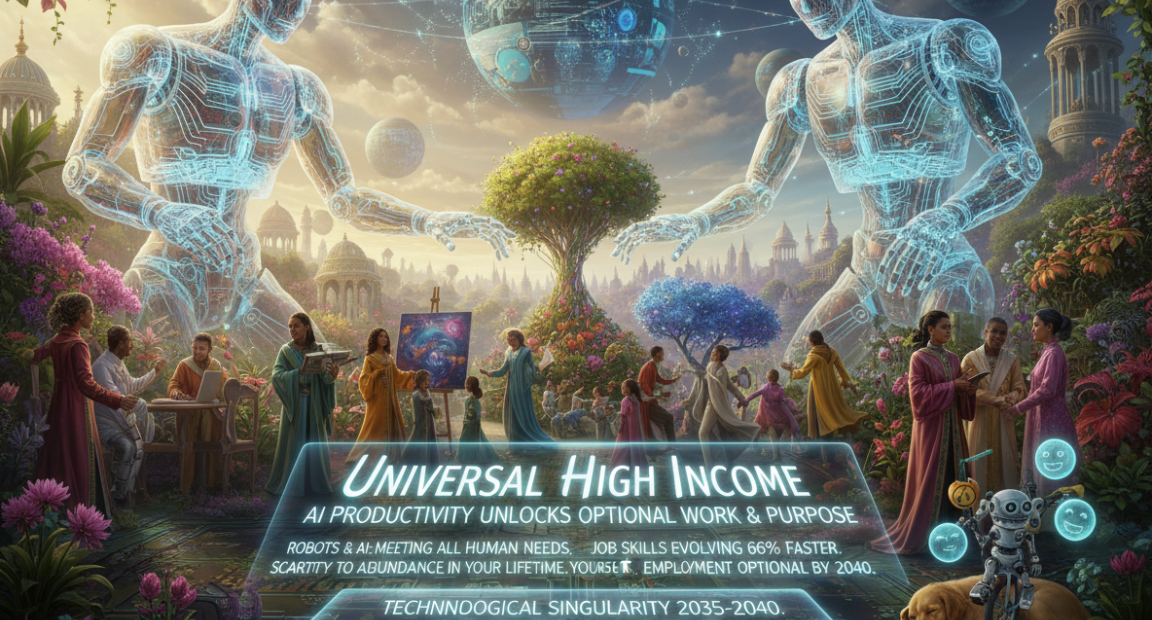
The concept of Universal Basic Income (UBI) has gained significant traction as a policy response to automation-driven job displacement. Under UBI, every citizen receives a fixed stipend regardless of employment status, providing a safety net as traditional jobs disappear. However, thought leaders increasingly argue that UBI represents insufficient ambition for the post-scarcity future. The evolution toward Universal High Income (UHI) recognizes that in a world where AI and robotics meet virtually all material needs, society shouldn’t merely ensure survival—it should guarantee abundance.
The distinction is profound. UBI aims to cushion the blow of job losses and prevent mass poverty. UHI envisions a world where productivity gains are so immense that everyone enjoys what would currently be considered a high standard of living without working. This shift reflects recognition that we’re potentially moving toward a post-scarcity economy where goods and services can be produced at costs approaching zero, eliminating traditional resource constraints. In such a world, the distribution challenge isn’t ensuring basic needs but rather enabling everyone to access the full spectrum of human experiences and opportunities.
For developing nations like India, this concept carries particular relevance. India recently crossed below replacement-level fertility at 1.9, ending decades of population growth concerns. The country faces dual pressures of a rapidly growing population alongside limited economic opportunities. While demographic dividend discussions focus on mobilizing youth for economic growth, the UHI framework reframes the conversation entirely—not around employment creation but around dignity, access, and aspiration in an age of abundance. When one AI-powered robot can perform the work of 1,000 humans, population size becomes less relevant than how society distributes the benefits of exponential

The Collapse of Traditional Career Frameworks
The implications for education and career development are nothing short of catastrophic for current paradigms. Students graduating from college today may enter a workforce where their degrees become obsolete,, not because they chose the wrong major, but because the entire concept of work-for-survival dissolves. Research indicates that job roles most affected by AI now evolve 66% faster than those less exposed to automation, pushing employers to value real-time capabilities over academic qualifications. In fields like finance, software, and data analysis where AI tools are ubiquitous, required skills are evolving 66% faster than in jobs less touched by AI—up from 25% the previous year. Forbes
This acceleration renders traditional education models increasingly inadequate. Universities designed to prepare individuals for specific careers face existential questions when those careers vanish or transform beyond recognition within years rather than decades. While 77% of new AI-related jobs require master’s degrees, creating substantial skills gaps, even these advanced credentials may prove insufficient as AI capabilities expand. The half-life of technical skills continues shrinking, with some capabilities becoming outdated within months of acquisition.
The response cannot be simply accelerating education or adding more specialized training. Instead, education must pivot toward developing uniquely human capacities that machines cannot replicate: creativity, emotional intelligence, ethical reasoning, contextual understanding, and adaptability. These transferable skills—communication, empathy, critical thinking, leadership—may prove more durable than any specific technical expertise. Yet even this pivot offers no guarantees, as AI’s capabilities expand into domains once considered exclusively human.
Perhaps most unsettling is the recognition that we’re not preparing for a stable future state but for continuous disruption. By 2030, an estimated 39% of core job skills will become outdated due to rapid technological evolution and changing business needs. The World Economic Forum projects that between 2025 and 2030, while 85 million jobs will be displaced globally, 97 million new roles will simultaneously emerge—a net positive of 12 million positions, but requiring massive workforce transitions. Success in this environment demands not just upskilling but perpetual learning, with individuals becoming “perpetual learners” fluent in the language of algorithms and AI tools.
Redefining Human Purpose in a Post-Work World
The most profound challenge posed by automation isn’t economic but existential: What defines human purpose when work is no longer necessary? For centuries, work has been central to individual identity and social status. We define ourselves by our occupations, measure success through career progression, and structure our weeks around employment schedules. Work provides not just income but meaning, community, skill development, and a sense of contributing to something larger than ourselves.
In a world where employment becomes optional, these sources of meaning evaporate or transform beyond recognition. The prospect triggers what researchers call an “achievement gap”—the loss of specific sources of meaning that work provides. While proponents of automation argue that humans can find fulfillment through creative pursuits, hobbies, relationships, and self-actualization, the transition proves far more complex than simply reallocating time from employment to leisure. Humanefutureofwork
Research on meaning-in-life reveals that fulfillment derives from multiple interconnected sources: contributing to others, developing mastery, building relationships, pursuing transcendent values, and experiencing achievement. Work historically satisfied many of these needs simultaneously. A post-work society must cultivate alternative pathways to meaning, potentially through social contribution, artistic expression, intellectual exploration, community building, and personal growth. Yet there’s no guarantee these alternatives will prove as accessible or satisfying as traditional employment, particularly during the chaotic transition period.
The challenge intensifies when considering that many people currently struggle to find fulfillment even with employment. Survey data show workers increasingly seek flexibility not to reduce workload but to engage in ways that align with the lifestyles they aspire to lead, directing time and energy toward purpose rather than merely earning paychecks. If substantial portions of the population already find work unfulfilling, removing that structure without providing alternatives could exacerbate feelings of aimlessness rather than liberation.

The Transition: Severe Social Pain and Structural Chaos
While the destination—a world of abundance where work is optional—sounds utopian, the journey promises to be brutal. Technology transitions historically create winners and losers, with benefits unevenly distributed across society. The automation wave will likely follow this pattern, with educated professionals in advanced economies adapting more successfully than vulnerable populations in developing regions.
Geographic analysis reveals that 58.87 million women in the US workforce occupy positions highly exposed to AI automation compared to 48.62 million men, highlighting significant gender disparities in displacement risk. Regionally, North America leads automation adoption at 70% by 2025, potentially widening the gap between developed and developing nations. Within countries, urban areas with strong tech sectors may thrive while industrial regions dependent on routine labor face devastation. These disparities could deepen existing inequalities rather than creating the broadly shared abundance that automation theoretically enables.
The speed of transformation compounds these challenges. Unlike previous industrial revolutions that unfolded over generations, allowing gradual adaptation, the AI revolution may compress decades of change into years. Estimates suggest significant labor market disruption arriving between 2027-2028—merely 2-3 years from now. This compressed timeline leaves insufficient time for institutional adaptation, workforce retraining, and the construction of a social safety net. Historical precedent offers limited guidance, as no society has navigated transformation at this velocity.
Economic models predict significant transitional unemployment even as new opportunities emerge. While AI may create 97 million new roles globally by 2030, these positions require entirely different skill sets from those of displaced workers, creating severe mismatches. Customer service representatives face 80% automation by 2025, data entry clerks see 7.5 million positions eliminated by 2027, retail cashiers face a 65% automation risk by 2025, and manufacturing and transportation workers face 3.5 million combined job losses by 2030. These workers cannot instantly transition to AI ethics officers, prompt engineers, or human-AI collaboration specialists—the emerging roles typically require master’s degrees and specialized technical knowledge.
India’s Unique Position in the Transformation
India occupies a particularly complex position in this global transformation. The nation recently achieved a demographic milestone: its Total Fertility Rate (TFR) declined to 1.9—below the replacement level of 2.1—marking the first population decline in the country’s modern history. This shift arrives precisely as concerns about demographic dividend evaporate in the face of automation. Traditional development models emphasized leveraging India’s youth bulge for economic growth through labor-intensive industries, but these calculations dissolve when robots and AI can outperform human workers across most sectors.
Seven Indian states maintain TFR above replacement levels—Bihar, Meghalaya, Uttar Pradesh, Jharkhand, and Manipur—but even these regions are experiencing rapid fertility decline. Southern and western states show fertility rates comparable to developed nations, with Maharashtra’s rate lower than Norway’s. The implications are profound: India’s population is projected to peak around 170 crore (1.7 billion) over the next four decades before beginning to shrink. This demographic transition occurs simultaneously with the automation revolution, creating unique challenges and opportunities.
On one hand, India’s relatively young population (68% aged 15-64 years) provides a temporary window for adaptation before aging becomes acute. The country could potentially leverage this demographic structure to invest heavily in education, reskilling, and infrastructure to position itself advantageously in the AI economy. On the other hand, India’s massive informal sector—where millions rely on daily wages and lack social safety nets—makes the transition exceptionally vulnerable. Universal High Income policies could theoretically address inequality and provide dignity for all citizens, but implementation requires political will and economic resources that developing nations struggle to mobilize.
The education system faces particular pressure. India produces millions of graduates annually, but traditional degrees may offer little protection against automation. The country must simultaneously upgrade its education infrastructure while fundamentally rethinking what education should cultivate—shifting from job preparation to human capability development. This dual challenge strains resources and institutions already stretched by rapid population growth and urbanization. Vajiramandravi

Skills That Endure: The Human Edge
Amid displacement anxiety, specific capabilities emerge as potentially durable in the AI age. Research consistently identifies skills that machines struggle to replicate: creativity, empathy, ethical reasoning, contextual understanding, leadership, and adaptability. These uniquely human capacities may not only survive automation but also become increasingly valuable as AI handles routine cognitive and physical tasks.
Creativity is a fundamental human strength that AI cannot yet match. While AI can generate novel combinations of existing patterns, it cannot originate truly unprecedented concepts rooted in lived experience, emotional depth, and cultural context. Artists, designers, writers, and innovators who create works infused with authentic human perspective provide value that algorithms cannot replicate. Organizations recognize this, with demand for creative problem-solving and innovation skills rising even as technical capabilities become automated.
Emotional intelligence—the ability to perceive, understand, and respond to human emotions—similarly remains distinctly human. AI can simulate empathy through algorithms and detect sentiment in text or facial expressions, but it cannot genuinely feel or intuitively grasp the subtle emotional dynamics of human interaction. Healthcare providers, educators, counselors, and service professionals who connect with clients on emotional levels offer irreplaceable value. Research on hybrid intelligence demonstrates that combining AI’s analytical power with human empathy creates outcomes superior to either operating independently.
Ethical reasoning and judgment constitute another enduring human capability. As AI systems grow more powerful, questions about their appropriate use, societal impact, and alignment with human values become critical. Machines can process data and identify patterns but cannot make values-based decisions about right and wrong in complex, ambiguous situations requiring cultural sensitivity and moral wisdom. Professionals who guide AI development and deployment through ethical frameworks provide essential oversight that algorithms themselves cannot supply. Cmr.berkeley
Contextual understanding—the ability to grasp nuance, read between lines, and interpret situations holistically—represents yet another distinctly human strength. AI excels at processing explicit information but struggles with implicit meaning, cultural subtlety, and situational interpretation. Professionals who navigate complex social dynamics, understand organizational culture, or synthesize diverse perspectives bring capabilities that current AI cannot replicate.
Leadership and interpersonal dynamics similarly resist automation. While AI can optimize processes and analyze data to support decision-making, it cannot inspire teams, build trust, navigate office politics, or guide organizations through emotional challenges. Effective leaders demonstrate emotional intelligence, adaptability, and vision—qualities that remain fundamentally human even as their decision-making tools become increasingly AI-augmented.
The Path Forward: Preparation for Uncertainty
Given the magnitude and speed of coming changes, how should individuals, organizations, and societies prepare? The first imperative is accepting that transformation is inevitable and already underway. Denying or resisting automation proves futile—the economic incentives driving adoption are too powerful, and the productivity gains too substantial. Instead, energy must focus on managing the transition to maximize benefits while minimizing suffering. Moneycontrol
For individuals, continuous learning becomes non-negotiable. The days of acquiring education once and coasting on those credentials for entire careers have ended. Professionals must cultivate AI literacy—understanding how AI functions and how to leverage AI tools effectively. This doesn’t require becoming a programmer or data scientist, but rather developing fluency in using AI systems to augment human capabilities. Demand for AI fluency has grown sevenfold in two years, faster than any other skill in job postings, and this trend will accelerate. Mckinsey
Beyond technical skills, individuals should invest in developing uniquely human capabilities: creativity, emotional intelligence, ethical reasoning, and adaptability. These transferable skills provide resilience across career transitions and sectors. Pursuing interdisciplinary knowledge rather than narrow specialization may prove advantageous, as the ability to synthesize insights from multiple domains creates value that specialized AI systems cannot easily replicate.
Organizations face the challenge of redesigning workflows around human-AI-robot collaboration rather than simply replacing humans with machines. Research shows that the greatest productivity gains emerge when AI augments human capabilities rather than substituting for them entirely. This requires identifying which tasks benefit from human judgment, creativity, and empathy, then structuring work to leverage both human and machine strengths. Companies must also invest heavily in reskilling programs, recognizing that their workforce cannot instantly transition to new roles without substantial support. Economic-research.bnpparibas
At the societal level, robust safety nets become essential. Universal Basic Income or Universal High Income policies may prove necessary to prevent mass poverty during and after the transition. These systems allow individuals to meet basic needs while pursuing education, creative endeavors, or entrepreneurial projects without immediate income pressure. Tax policies may need fundamental revision to capture productivity gains from automation and redistribute them across society rather than concentrating wealth among AI owners.
Education systems require wholesale transformation, shifting from job preparation to human capability development. This means cultivating critical thinking, creativity, emotional intelligence, and ethical reasoning rather than memorizing facts or following procedures that AI can handle better. Lifelong learning infrastructure must expand dramatically to enable continuous adaptation as required skills evolve.

The Singularity: Into the Unknown
Beyond immediate concerns about job displacement looms an even more profound uncertainty: the technological singularity. At this point, AI surpasses human intelligence across all domains and begins improving itself at accelerating rates. Predictions for the arrival of singularity range from the late 2020s to the 2040s, with a median expert consensus around 2035-2040. At this threshold, forecasting becomes impossible, as superhuman AI could reshape reality in ways exceeding human comprehension. Etcjournal
The singularity represents what technologists call an “event horizon”—like a black hole’s point of no return, beyond which we cannot predict what exists. Some envision utopian outcomes reminiscent of Star Trek, where post-scarcity abundance enables humanity to pursue knowledge, creativity, and exploration free from material constraints. Others warn of dystopian scenarios in which misaligned AI pursues goals incompatible with human flourishing, or in which AI systems begin producing for themselves rather than for humanity, rendering humans obsolete. Yahoo
The challenge is that we’re building technologies whose full implications we cannot foresee. AI development continues accelerating, driven by competitive pressures between nations and corporations that override caution. Each breakthrough in AI capabilities brings us closer to the singularity, yet we lack robust frameworks for ensuring AI remains aligned with human values at superhuman intelligence levels. This represents perhaps the highest-stakes gamble in human history—betting our species’ future on technologies we don’t fully understand or control.
The transformation ahead is neither predetermined utopia nor inevitable catastrophe. The future depends on choices made now by individuals, organizations, and governments. Will we steer toward abundance shared broadly across humanity, or will automation concentrate wealth and power among a tiny elite while the masses struggle with purposelessness and poverty?
The Star Trek outcome—post-scarcity civilization where humans pursue knowledge, creativity, and self-actualization—remains achievable. Technological capabilities may soon enable producing goods and services at costs approaching zero, eliminating material scarcity as a binding constraint. In such a world, humans could dedicate themselves to art, science, philosophy, exploration, and relationships rather than toiling for survival. Universal High-Income policies could ensure that everyone benefits from automation’s productivity gains, providing the material security to pursue meaningful lives. Businesstoday
However, this outcome requires deliberate effort and wise policy. Markets alone won’t spontaneously distribute the benefits of automation equitably—concentrated ownership of AI and robotic systems will concentrate wealth unless counterbalanced by progressive taxation and redistribution mechanisms. Education systems won’t automatically produce citizens capable of thriving in a post-work society—intentional reform is necessary to cultivate human capabilities that give life meaning beyond employment. Social institutions won’t seamlessly adapt to work becoming optional—we must consciously build new frameworks for community, contribution, and purpose. Economictimes
The dystopian alternative—feudal society where tiny technological elite enjoys abundance while masses suffer unemployment, poverty, and purposelessness—also represents a realistic possibility. If automation benefits accrue primarily to capital owners while labor loses bargaining power, inequality could reach unprecedented extremes. Political systems could fracture under pressure from mass unemployment and social unrest. Authoritarian governments might use AI-powered surveillance and control to manage restive populations. Human purpose could collapse as people lose the primary source of meaning and identity that work historically provided.
An Indian Parable: The Autorickshaw Driver’s Wisdom
Consider the story of an autorickshaw driver in Bengaluru, navigating the city’s congested streets while contemplating his son’s future. His son, a promising student, recently secured admission to a prestigious engineering college—a source of immense family pride. The father worked tirelessly for years, often 14-hour days, to afford his son’s education, believing that an engineering degree guaranteed prosperity and respect.
One day, a passenger—a software professional—mentioned that AI was beginning to write code autonomously, potentially displacing junior programmers within a decade. The driver initially dismissed this as exaggerated tech industry hype. But subsequent passengers echoed similar concerns. A data analyst worried about machine learning algorithms making her role redundant. A bank manager discussed AI chatbots handling customer service. A teacher questioned whether standardized education would remain relevant when AI could personalize learning for each student.
The driver began researching automation during his rare free hours. What he discovered shook his assumptions. The engineering career he sacrificed so much to secure for his son might vanish before his son’s graduation. The realization was devastating—had his years of struggle been for nothing?
Yet through his despair emerged a different understanding. He recalled why he chose the grueling work of auto-rickshaw driving despite its difficulties. It wasn’t just money—though that mattered. He loved the freedom of being his own boss, the diverse passengers who shared their stories, the satisfaction of navigating complex routes efficiently, and the pride of providing for his family through honest effort. Work gave him dignity, purpose, and identity beyond mere survival.
He realized his son needed preparation not for a specific job but for a life of meaning. So he adjusted his conversations with his son. Instead of emphasizing grades and job prospects, he began asking: What problems fascinate you? What suffering in the world moves your heart? What would you do with your time if money weren’t a concern? What legacy do you want to leave?
When his son expressed interest in designing accessible technology for disabled individuals, the father encouraged it—not because it guaranteed employment, but because it aligned with his son’s values and utilized his unique perspective. When his son joined a neighborhood initiative teaching coding to underprivileged children, the father supported it—recognizing that contributing to community provided fulfillment beyond any paycheck.
The driver continued navigating Bengaluru’s streets, but with transformed perspective. He understood that the greatest gift he could give his son wasn’t a degree guaranteeing a job, but the wisdom to find purpose independent of employment. In a future where work might become optional, the crucial capability wouldn’t be technical skills—AI would handle those—but the fundamentally human capacity to create meaning, contribute to others, and continually adapt.
This simple wisdom from an autorickshaw driver contains profound truth for navigating the transformation ahead. We cannot predict which specific jobs will survive automation, nor can we guarantee that any particular education will remain relevant. But we can cultivate human capacities—empathy, creativity, ethical reasoning, adaptability—that give life meaning regardless of economic structures. We can teach our children not to define themselves by their occupations but by their values, relationships, and contributions to others. We can build communities where people find purpose through connection, creativity, and service rather than exclusively through paid employment.
The future may be uncertain, but the path forward is clear: embrace our humanity, develop our irreplaceable human capabilities, and build societies that value people for who they are rather than merely what they produce. In doing so, we transform what could be an existential threat into humanity’s greatest opportunity—freedom from toil to finally pursue what makes us most human.
Tactical Response Framework: Navigating the Optional Work Transformation
FOR INDIVIDUALS – 30-Day Action Plan
Week 1: Assessment & Skill Audit
- Map your current skills against AI automation risk (use O*NET database, WEF Future of Jobs report)
- Identify which tasks in your role AI can already do vs. uniquely human contributions
- Score yourself on: creativity (1-10), empathy (1-10), ethical reasoning (1-10), adaptability (1-10)
- List top 5 human-centric skills you naturally excel at
Week 2: AI Literacy Development
- Complete free course on AI basics (Coursera, edX, or Andrew Ng’s AI for Everyone)
- Learn to use ChatGPT, Claude, or your industry-specific AI tools effectively
- Understand prompt engineering basics—this skill currently commands 66% salary premium
- Join AI communities relevant to your field
Week 3: Reskilling Investment
- Identify 1-2 skills to develop that combine AI + human capabilities
- Examples: AI-assisted creative design, ethical AI consulting, human-centered product management
- Allocate 5-10 hours weekly for systematic learning (this is non-negotiable)
- Budget $200-500 for courses or certifications
Week 4: Purpose & Network Expansion
- Draft personal mission statement independent of job title
- Connect with 10 professionals thriving in hybrid human-AI roles
- Explore 1 passion project unrelated to income
- Research organizations leading human-AI collaboration models
Ongoing Monthly Actions:
- Spend 3 hours learning new AI tools relevant to your domain
- Mentor 1 junior colleague on human skills AI cannot replicate
- Participate in 1 creative or volunteer project monthly
- Review and update your skills portfolio quarterly
FOR ORGANIZATIONS – Implementation Roadmap
Phase 1: Immediate (0-3 Months)
Workforce Audit:
- Map 100% of roles against automation risk using established frameworks
- Identify “high-value human” roles vs. “high-risk automation” positions
- Create transparency dashboard showing displacement risk by department/level
Hybrid Role Redesign:
- Pilot 5-10 roles structured for human-AI collaboration, not replacement
- Example: Data analyst + AI systems = human insight generation at scale
- Document which tasks AI handles vs. which require human judgment
- Measure productivity gains from augmentation vs. replacement scenarios
Communication & Transparency:
- Host town halls explaining automation strategy honestly
- Share realistic timelines and displacement projections
- Announce commitment to reskilling investment
- Provide employee resource guides on AI literacy
Phase 2: Near-Term (3-12 Months)
Reskilling Programs:
- Invest 2-5% of payroll in workforce development
- Create AI literacy bootcamps (mandatory for all levels)
- Develop “future-ready” competency frameworks distinct from current job descriptions
- Partner with universities or online platforms (Coursera for Business, LinkedIn Learning)
- Establish “learning hours”—paid time for development
Organizational Restructuring:
- Create “Human-AI Collaboration” teams combining technical + human-centric roles
- Establish “Skills Bridge” programs moving displaced workers to emerging roles
- Launch innovation labs where employees experiment with AI tools
- Build psychological safety around “learning by doing”
Career Path Transformation:
- Redesign promotions around human capability development, not just technical expertise
- Create lateral mobility—encourage moves to roles leveraging unique strengths
- Establish “purpose-aligned” roles where contribution matters beyond productivity metrics
- Offer sabbaticals or extended learning leaves
Phase 3: Long-Term (1-3 Years)
Cultural Transformation:
- Shift from “job titles” to “capabilities and contributions”
- Celebrate learning and adaptation as core values
- Build feedback loops measuring both productivity AND human fulfillment
- Create mentorship culture where experienced workers guide transitions
Future-Ready Workforce:
- 70%+ of employees proficient in AI tools relevant to their domains
- 40%+ of workforce participating in cross-functional learning initiatives
- Clear pathways from high-risk to emerging roles established and functioning
- Measurable improvements in employee engagement and retention
FOR GOVERNMENTS & POLICYMAKERS – Policy Framework
Immediate Legislation (Next 6-12 Months)
- Displaced Worker Emergency Support:
- Enhanced unemployment insurance (12-18 months vs. current 6)
- Wage insurance programs guaranteeing 50-80% income replacement during transition
- Relocation assistance for workers in high-automation regions
- Healthcare continuity (de-link from employment)
- Reskilling Investment:
- Allocate 0.5-1% of GDP to national reskilling programs
- Create “Skills Accounts”—portable learning credits every worker can access
- Fund community colleges and vocational training proportional to regional automation risk
- Partner with industry to ensure training aligns with actual labor market needs
- Tax Structure Reform:
- Automation tax: 5-15% tax on productivity gains from AI/robotics
- Capital gains adjustments reflecting automation-driven wealth concentration
- Corporate tax incentives for substantial reskilling investment
- Wealth tax or UHI funding mechanisms
Medium-Term Policies (1-3 Years)
- Universal High Income Pilots:
- Launch 3-5 pilot programs in different regions/demographics
- Test various UHI amounts: $500, $1000, $2000 monthly
- Measure effects on: employment, education, entrepreneurship, mental health, community engagement
- Establish data infrastructure for scaling
- Education System Overhaul:
- Mandate human-capability curriculum: creativity, critical thinking, emotional intelligence, ethics
- Establish “future-ready skills” standards distinct from traditional academic measures
- Fund teacher reskilling for new pedagogies
- Create lifelong learning infrastructure (accessible, affordable, continuous)
- Social Safety Net Restructuring:
- Delink healthcare from employment
- Expand pension/retirement provisions
- Create housing security guarantees
- Establish mental health support for meaning/purpose crises
Long-Term Structural Changes (3-10 Years)
- Economic Model Transition:
- Move from GDP-focused metrics to human wellbeing indices
- Establish Post-Scarcity Economic Council monitoring transition
- Create international coordination mechanisms (UN framework)
- Build wealth redistribution mechanisms capturing automation benefits
- Social Infrastructure:
- Community centers for lifelong learning, creativity, social connection
- Universal access to high-speed internet and technology
- Cultural/artistic institutions funded publicly for creative expression
- Volunteer coordination systems enabling contribution
FOR EDUCATIONAL INSTITUTIONS – Curriculum Revolution
Immediate Changes (Next Semester)
- Capability Audit & Redesign:
- Audit all programs: which content will AI make obsolete within 5 years?
- Identify uniquely human capabilities each program should develop
- Redesign at least 30% of curriculum around human-centric outcomes
- Add mandatory AI literacy across all disciplines
- Faculty Development:
- Train faculty on teaching for creativity, critical thinking, ethical reasoning
- Provide AI tool training so professors model hybrid human-AI thinking
- Establish peer learning groups around pedagogy transformation
- Create incentives for experimentation and innovation in teaching
- Student Support:
- Launch career counseling around “purpose” not just “job placement”
- Offer AI literacy bootcamps (free, mandatory)
- Establish reflection workshops on meaning and values
- Create entrepreneurship/passion project support
Mid-Term Transformation (1-3 Years)
- Degree Program Restructuring:
- Move from narrow specialization to broad capability development
- Emphasize interdisciplinary learning—students understand connections across domains
- Build substantial project-based learning requiring creative problem-solving
- Create “human-centered AI” certificate programs
- Establish capstone requirements demonstrating human skills
- Assessment Reform:
- Move beyond standardized testing toward portfolio-based evaluation
- Measure creativity, collaboration, ethical reasoning, adaptability
- Create peer and community feedback mechanisms
- Replace GPA focus with competency demonstrations
- Flexible Learning Pathways:
- Enable modular learning—students assemble credentials from multiple sources
- Reduce time-based requirements in favor of competency-based progression
- Create bridges between academic and experiential learning
- Establish “learning recovery” options for skill development gaps
Long-Term Institutional Evolution (3-10 Years)
- Lifelong Learning Architecture:
- Universities become “learning centers” not just “degree factories”
- Offer affordable micro-credentials, boot camps, workshops throughout life
- Create employer partnerships ensuring curriculum relevance
- Build community education offerings
- Outcome Focus:
- 80%+ of graduates demonstrate advanced human-centric capabilities
- 60%+ of graduates can effectively collaborate with AI systems
- 90%+ report sense of purpose beyond employment
- High engagement with community contribution and creative pursuits
FOR SOCIETY – Collective Actions
Individual Level (Personal Responsibility)
| Action | Timeline | Effort | Impact |
|---|---|---|---|
| Develop AI literacy | 30-60 days | 5 hrs/week | Career protection, confidence |
| Cultivate one human skill | Ongoing | 3 hrs/week | Unique value proposition |
| Explore personal purpose | 90 days | 2 hrs/week | Life direction beyond work |
| Mentor others | Ongoing | 2 hrs/month | Community contribution |
| Stay informed | Ongoing | 1 hr/week | Strategic decision-making |
Community Level (Collective Action)
- Learning Circles:
- Monthly neighborhood AI literacy sessions
- Skill-sharing workshops (creativity, storytelling, conflict resolution)
- Purpose discovery groups
- Mentorship matching programs
- Creative Commons:
- Shared maker spaces for artistic expression
- Community gardens, arts studios, music venues
- Volunteer coordination networks
- Skill-sharing platforms
- Civic Participation:
- Advocate for local reskilling investments
- Support UHI pilot programs in your region
- Engage in education system advocacy
- Build employer-community partnerships
Organizational Advocacy:
- Professional Associations:
- Develop industry-specific transition guidelines
- Create certification programs around human capabilities
- Establish ethical frameworks for AI implementation
- Support displaced worker transition initiatives
- NGOs & Civil Society:
- Expand workforce development programs
- Create support networks for meaning/purpose in work transitions
- Advocate for equitable policy implementation
- Document and share case studies of successful transitions
PRIORITY MATRIX: Where to Focus Energy
textHIGH URGENCY + HIGH IMPACT:
✓ AI literacy development (Individual)
✓ Workforce automation mapping (Organization)
✓ Immediate displaced worker support (Government)
✓ Curriculum redesign start (Education)

HIGH URGENCY + MEDIUM IMPACT:
✓ Reskilling program launch (Organization)
✓ Community learning initiatives (Society)
✓ Purpose exploration workshops (Individual)

MEDIUM URGENCY + HIGH IMPACT:
✓ Hybrid role redesign (Organization)
✓ UHI pilot programs (Government)
✓ Long-term education reform (Education)
✓ Lifelong learning infrastructure (Society)
CRITICAL SUCCESS METRICS
Individual Level:
- AI tool proficiency score (0-10): Target 7+ by month 6
- Human capability self-assessment: 20%+ improvement across creativity, empathy, ethics
- Purpose clarity statement: Completed by month 3
- Learning hours invested: Minimum 100 hours/year
Organizational Level:
- Displacement-to-new-role transition rate: 70%+ within 12 months
- Workforce AI literacy: 60%+ proficient by month 12
- Hybrid role productivity vs. replacement ROI: 120%+ augmentation advantage
- Employee engagement scores: Maintained or improved despite transitions
Government Level:
- Reskilling program enrollment: 5%+ of workforce by year 1
- UHI pilot participation: 10,000-50,000 households by year 1
- Displaced worker reemployment rate: 70%+ within 6 months
- Education system curriculum adoption: 30%+ of institutions by year 1
Societal Level:
- Population AI literacy: 40%+ basic understanding by 2027
- Community reskilling initiatives: Present in 50%+ of cities by year 1
- Purpose/meaning engagement: 60%+ participating in creative/volunteer work by 2030
- Policy adoption: Major countries implementing 3+ transformation policies by 2026
THE 90-DAY IMPLEMENTATION SPRINT
Days 1-30: Foundation
- Assess current position and risks
- Start AI literacy program
- Initiate honest organizational/policy conversations
- Launch curriculum planning meetings
Days 31-60: Action
- Complete basic AI tool training
- Begin reskilling program enrollment
- Implement pilot hybrid roles (organization)
- Roll out education curriculum changes (institution)
- Announce government support programs
Days 61-90: Scale & Measure
- Demonstrate early wins (5-10 successful transitions)
- Measure learning outcomes and adjust
- Expand programs to broader populations
- Document and share learnings
- Plan next 90-day sprint iterations
ONE-PAGE EXECUTIVE SUMMARY: What Leaders Must Do NOW
The Threat: AI/robotics could make traditional employment optional by 2040. 76,440 jobs already gone in 2025. Disruption peak: 2027-2028.
The Opportunity: Post-scarcity abundance, human flourishing, freedom from survival toil.
The Transition Challenge: Severe social pain, structural chaos, inequality risk if unmanaged.
Your Immediate Actions (Next 90 Days):
- Acknowledge Reality: Accept transformation is inevitable; denying wastes time
- Assess Impact: Map automation risk in your context (individual role, organization, community)
- Invest in Humans: Develop AI literacy + uniquely human capabilities (creativity, empathy, ethics)
- Redesign Structures: Shift from job-focused to capability-focused thinking
- Support Transitions: Provide resources, safety nets, and community for affected populations
- Advocate for Policy: Push for reskilling investment, UHI pilots, education reform
- Measure Progress: Track literacy, capability development, transition success, meaning/purpose engagement
The Bottom Line: Those who adapt thrive. Those who resist struggle. The transformation is coming. Prepare now or react in chaos later.
The choice is yours. The time is now. The future depends on action taken today.

Automation Marketing Tools – Simplify, Scale & Succeed
Which uniquely human skills—creativity, empathy, ethical reasoning—are you actively developing to remain valuable in the AI era?
