
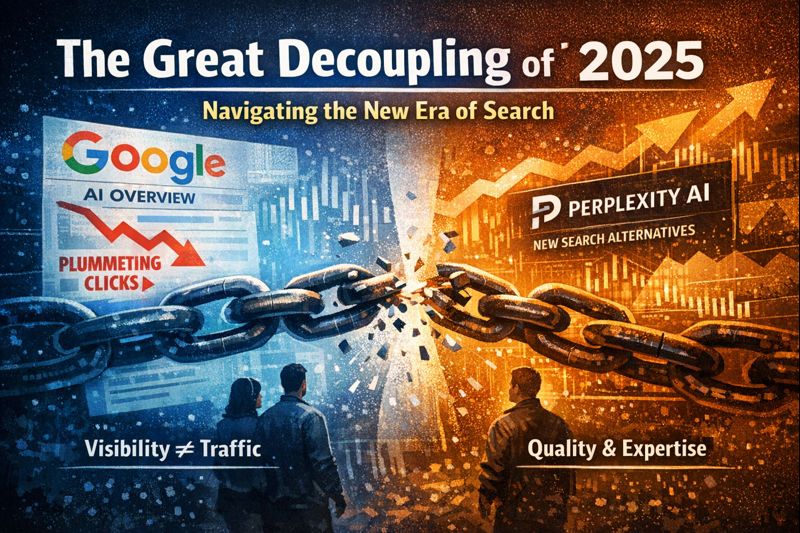
The Great Decoupling: How AI Search has Reshaped Digital Visibility in 2025
Key Insight: The search landscape transformed dramatically in 2025, with artificial intelligence fundamentally reshaping how content is discovered, ranked, and delivered to users. While Google expanded AI Overviews to 30% of queries at their peak, the industry witnessed declining click-through rates, shifting market dominance, and a radical reimagining of what “ranking” actually means. For businesses and creators, success no longer depends solely on claiming the top position—it depends on visibility within AI-generated answers, adaptation to new ranking systems like Perplexity’s sophisticated ML rerankers, and compliance with increasingly stringent quality standards that reward human expertise over automated shortcuts.
1. The AI Overview Explosion: When Search Results Became Answers
The most consequential shift in 2025 was Google’s aggressive expansion of AI Overviews—instant AI-generated summaries that synthesize information from multiple sources rather than simply linking to individual pages. Unlike featured snippets that extract content from a single source, AI Overviews consolidate knowledge to deliver unified answers directly on the search results page.
The adoption curve was dramatic. AI Overviews appeared on just 6.5% of U.S. desktop queries in January 2025, expanding to 25% by July before reaching a peak of nearly 30% in September. However, Google pulled back slightly to 16% by November, suggesting internal recalibration based on user feedback. This volatility itself signals an important truth: Google is in active experimentation mode, testing the boundaries of how AI can replace traditional search.

Google AI Overviews Expansion & Click-Through Rate Impact (January-November 2025)
The seismic impact wasn’t limited to search volume—it fundamentally altered user behavior. Research from Seer, Ahrefs, Amsive, and BrightEdge revealed a pattern that multiple firms independently documented: impressions increased while clicks plummeted. Organic click-through rates dropped by as much as 61% for non-branded, informational queries, where AI Overviews pushed traditional search results below the fold. The phenomenon earned a telling name in the industry: “The Great Decoupling”—where rising visibility no longer translated to traffic gains.

AI SEO Strategy for 2025: The Future of Search Engine
The transformation extended beyond pure informational queries. In early 2025, AI Overviews dominated informational searches (91% in January), but by October, coverage had shifted dramatically. Commercial queries grew from 8% to 18%, transactional queries from 2% to 14%, and most strikingly, navigational queries—brand searches that users would historically click through on—jumped from under 1% to over 10% by November. This expansion into commercial and navigational intent signaled Google’s confidence that AI Overviews could handle high-stakes queries where user trust is paramount.
Industry impact remained uneven. Science-related keywords accounted for AI Overviews in 25.96% of searches, with Computers & Electronics and People & Society following closely. Real Estate, Shopping, and Arts & Entertainment remained comparatively untouched, with AI Overviews appearing on fewer than 5% of keywords. This variance reflects Google’s cautious approach: deploying AI aggressively in domains with consensus answers and scaling back in spaces prone to misinformation or subjective preferences.

Industries Most Impacted by Google AI Overviews (November 2025)
2. AI Mode and the Future of Search: From Answers to Agency
Beyond AI Overviews, Google introduced AI Mode—a comprehensive redesign of the search experience that positioned Google as both a search engine and an autonomous research assistant. Users could opt in to an experience where Google’s Gemini 2.5 models conducted deeper research, took agentic actions on behalf of users, and delivered personalized results based on search history and explicit preferences.
AI Mode exposed transparency gaps that alarmed the industry. Early versions broke referral tracking entirely, making it impossible for websites to know if—or where—they appeared in AI-generated responses. Even as Google refined the feature, attribution remained opaque. Search Console began blending AI Mode traffic into standard reporting in December 2025, obscuring the distinction between traditional clicks and AI-mediated interactions.
This ambiguity created operational havoc for digital marketers. How do you optimize for visibility when you cannot measure visibility? How do you attribute conversions when the user journey is abstracted through an AI intermediary? For enterprises managing million-dollar marketing budgets, AI Mode represented a terrifying shift: the metric that had governed digital strategy for two decades—the click—was becoming increasingly abstract.

How does Google search (ranking) may be working today
3. Perplexity and the Rise of Specialized AI Search: The Multi-Vector Ranking Challenge
While Google expanded, Perplexity AI emerged as a formidable alternative, capturing users who preferred AI-native search experiences. In August 2025, independent researcher Metehan Yesilyurt published a groundbreaking analysis of Perplexity’s ranking methodology, revealing a sophisticated ecosystem fundamentally different from Google’s approach.
Perplexity deployed a three-layer (L3) XGBoost reranking system that scored, filtered, and sometimes discarded content based on quality gates. The system combined machine learning models with manual domain curation—GitHub and Stack Overflow received inherent authority boosts in tech searches, while Amazon and Walmart dominated e-commerce results.
Critical innovations distinguished Perplexity’s approach:
-
- Topic Multipliers: Content about AI, technology, and science received exponential visibility boosts, while entertainment and sports content faced severe penalties
-
- New Post CTR Windows: Fresh content had a critical 24-48 hour engagement window. Failure to achieve minimum click thresholds resulted in rapid visibility decline
-
- Time Decay: Content automatically loses visibility over time unless refreshed, encouraging continuous optimization rather than “set and forget” strategies
-
- Semantic Richness Thresholds: Content required substantial depth and comprehensiveness to clear quality gates
-
- Memory Networks: Interconnected content clusters ranked better when supporting articles cross-referenced each other
The implications rippled through the SEO industry. Optimizing for Perplexity wasn’t about keywords or backlinks—it required understanding entity disambiguation, topic classification systems, and the precise mechanics of ML-based reranking. For creators in high-value verticals (AI, technology, science), Perplexity visibility could become as important as Google ranking within a few years.

Content Creation Using Generative AI | Performics India
4. The HubSpot Cautionary Tale: When Authority Vanishes Overnight
No single event crystallized the dangers of algorithmic disruption more vividly than HubSpot’s organic traffic collapse. The company—ironically, a leader in content marketing and SEO expertise—watched its traffic plummet from 13.5 million monthly visits in November 2024 to 8.6 million in December. Some estimates suggested the blog lost 70-80% of its traffic within months.
The proximate cause was Google’s December 2024 algorithm update, which prioritized user-generated content and forums. But the root cause lay in strategic misalignment. HubSpot had built its blog on top-of-funnel (TOFU) content—high-traffic keywords with minimal relevance to HubSpot’s CRM solutions. Rankings for “resignation letter examples,” “cover letter templates,” and “what is your greatest weakness?” generated enormous pageviews but attracted users with zero commercial intent.
When Google tightened relevance signals in 2024-2025 updates, these pages became liabilities. They diluted domain authority, signaled misalignment with HubSpot’s core expertise, and failed E-E-A-T (Expertise, Experience, Authoritativeness, Trustworthiness) assessment under the new, stricter quality standards.
The lesson extended beyond a single company. Content built primarily for traffic rather than relevance would face increasing penalties as Google’s algorithms mature. AI-era SEO demanded ruthless honesty: Does this page serve the business? Does it reflect genuine expertise? Or is it filler optimized to extract search traffic?
5. The Spam and AI Content Reckoning: Quality Standards Tighten
Google’s January 2025 Search Quality Rater Guidelines update fundamentally shifted how the company evaluated AI-generated content. Rather than issuing blanket bans, Google recognized that AI tools could enhance content creation—but only when paired with human judgment, originality, and real expertise.
The guidance was unambiguous: pages where the main content consisted entirely of AI generation with minimal added value would receive “Lowest” quality ratings. Quality raters now assessed whether the content:
-
- Contained merely common knowledge or general facts without original insights
-
- Showed high overlap with established sources like Wikipedia or reference sites
-
- Summarized forum discussions or articles without meaningful additions
-
- Featured telltale AI indicators like “As an AI language model” or “In today’s times”
Simultaneously, Google expanded its spam definitions to target “scaled, low-effort” content. This marked a pivotal moment: the company wasn’t attacking AI as a tool; it was enforcing a quality floor that demanded human judgment, expertise, and originality.
The practical impact was swift. Websites that had rapidly scaled content through AI generation without human refinement began declining in rankings within weeks of the update’s rollout. Conversely, companies that used AI for draft generation, structural suggestions, and optimization while maintaining rigorous human editing saw minimal disruption.

Content Optimization 101: Getting The Basics
6. The Query Groups Revolution: Making Sense of Intent at Scale
Google added Query Groups to Search Console Insights in October 2025, automating a task that had consumed hundreds of SEO hours annually. Using AI clustering, Google now automatically groups similar search variations into intent-level topics, replacing sprawling lists of individual keywords with actionable topic clusters.
For novice SEOs and smaller teams, Query Groups democratized insights that had only been accessible to sophisticated practitioners. Instead of manually building regex filters or exporting data to external tools, site owners could now see:
-
- Which topic clusters drove the most clicks
-
- Trends within clusters (rising or declining visibility)
-
- Performance variations across group members
-
- Opportunities for consolidation, expansion, or pruning
More profoundly, Query Groups signaled Google’s confidence in AI-powered segmentation and its comfort level in making semantic judgments about query intent. If Google could reliably cluster thousands of query variations into meaningful groups, why not use that capability to refine rankings themselves? The tool was simultaneously useful and a subtle indicator of Google’s technical confidence.
7. Google’s Market Share Erosion: The End of a 15-Year Dominance
For a decade and a half, Google maintained search market dominance so complete it seemed immutable. But in October 2024, for the first time since 2015, Google’s global search share dipped below 90%. Throughout 2025, it remained consistently below 90%, hovering in the high 89% range.linkedin+2
In absolute terms, a 1% decline seemed trivial. In the context of digital dominance worth tens of billions annually, it was seismic. Erosion accelerated in late 2025, with some reports suggesting that U.S. market share reached 87.39% in December.
Multiple factors contributed to the shift:
-
- Bing’s improvement through tighter integration with ChatGPT
-
- Yandex’s growth in certain regions.
-
- ChatGPT Search and Perplexity AI is capturing mindshare among tech-savvy
-
- Regional shifts, particularly among Gen Z, preferring AI-native alternatives
-
- User fatigue with AI Overviews in some segments, prompting exploration of alternatives
The decline was uneven geographically, with Asia accounting for the largest share of losses, in emerging markets where mobile-first and AI-first behaviors were dominant, alternatives to Google established footholds.
8. The Great Scraping Reckoning: Cloudflare, Google, and the Economics of AI Training
The relationship between AI companies and content creators fractured spectacularly in 2025. Cloudflare CEO Matthew Prince articulated what many publishers felt: AI companies were harvesting content at an enormous scale while returning minimal traffic.
The data was damning. Internal analysis at Cloudflare revealed:
-
- Google crawled websites 14 times for every single referral to TechCrunch
-
- OpenAI crawled 1,700 times per referraltechcrunch
-
- Anthropic crawled 73,000 times per referraltechcrunch
This asymmetry threatened publishing economics. Websites invested resources in creating original content; AI companies trained models using that content with minimal permission or compensation.
In response, Cloudflare introduced a permission-based model for AI crawlers by default, requiring explicit consent before scraping. More ambitiously, it launched Pay per Crawl—a marketplace allowing publishers to charge AI companies for crawling access on a per-request basis. Website owners could choose to allow free scraping, charge micropayments, or block crawlers entirely while viewing exactly which crawlers accessed their content and for what purpose.
The move signaled an emerging business model: if AI companies wanted free training data, they would need to establish explicit economic relationships with creators. This wasn’t purely a Silicon Valley concern—it reflected fundamental questions about who owns content and who benefits from its use.techcrunch
9. The Parameter That Changed Everything: Google Removes num=100
On September 11, 2025, Google deprecated the &num=100 query parameter—a feature that had existed since the early days of search, allowing power users and tools to retrieve 100 results on a single page instead of the standard 10.
The impact cascaded through the SEO industry with surprising force. Rank tracking tools, which had relied on the parameter to capture the top 100 results in a single request, now required ten separate API calls—multiplying infrastructure and bandwidth costs by ten fold. For massive SEO platforms managing millions of keywords, the cost increase was substantial.
Search Console impressions also shifted dramatically. Much of the reported visibility in GSC had come from bot traffic generated by rank trackers using the &num=100 parameter. With the parameter removed, this phantom traffic disappeared, causing many sites to report sharp drops in impressions even when actual rankings remained stable.
The removal served Google’s strategic interests: improved server efficiency, alignment with mobile-first user behavior (100 results on a tiny screen was impractical), reduced data scraping, and cleaner metrics reflecting actual human behavior. For the industry, it represented another reminder that Google could alter the fundamental assumptions underlying SEO infrastructure with minimal warning. Decodo
10. AI-Generated Content: When Efficiency Becomes Liability
Throughout 2025, the paradox of AI-generated content became increasingly apparent. AI tools could accelerate content creation, improve consistency, and enhance optimization—but they could also hollow out the authenticity and expertise that modern search engines increasingly rewarded.
Google’s refined guidance distinguished between thoughtful AI-assisted creation and scaled, low-effort automation. Pages using AI for drafting, outlining, and structural suggestions while maintaining rigorous human editorial control showed resilience. Pages that published AI output with minimal review faced deteriorating rankings.
The distinction mattered because AI models, even sophisticated ones, struggled with certain dimensions that search quality raters assessed:
-
- Originality: AI synthesized existing information but rarely generated novel insights
-
- Authority: AI lacked the verifiable credentials and track record that authentic expertise required
-
- Voice: AI writing often lacked the distinctive perspective that built reader loyalty
-
- Accuracy: Without human verification, AI-generated content sometimes contained subtle errors
-
- Compliance: AI occasionally included language (“As an AI language model…”) that immediately signaled artificial generation
The emerging best practice: use AI as a collaborator, not a replacement. Humans provided expertise, voice, originality, and judgment; AI provided efficiency, structure, and optimization assistance. The synthesis delivered better results than either approach alone.
Strategic Implications: Adapting SEO for the AI Era
The ten dominant narratives of 2025 collectively revealed a search industry in transition. Several strategic imperatives emerged for creators, marketers, and platforms navigating the transformation:
Diversify Beyond Google: With Google’s dominance eroding and AI-native alternatives rising, building visibility in ChatGPT Search, Perplexity, and other generative engines became essential. The strategies differed (Perplexity favored topic clusters and rapid engagement; ChatGPT rewarded citation depth), requiring platform-specific optimization.
Prioritize Relevance Over Traffic Volume: HubSpot’s collapse exemplified the danger of pursuing traffic divorced from commercial intent or business focus. Successful strategies aligned content with authentic expertise, built authority through focused topical areas, and rejected traffic-at-all-costs tactics. Taktical
Master AI as a Tool, Not a Shortcut: Websites that thrived used AI to enhance human creativity and expertise, not replace it. The most effective approach combined AI-assisted research, drafting, and optimization with rigorous human editing, fact-checking, and originality. Engagecoders
Monitor Attribution Carefully: As AI Overviews, AI Mode, and generative search proliferated, traditional attribution metrics (organic clicks, referral traffic) became increasingly abstract. Forward-thinking teams built tracking systems for direct traffic, branded searches, and conversion paths that didn’t depend on precise click origin.
Invest in Topic Depth and Interconnection: Both Google’s Query Groups and Perplexity’s memory networks signaled that engines increasingly value topical comprehensiveness and interconnected content clusters over individual-article optimization. Successful strategies built content ecosystems rather than isolated articles.
Embrace Transparency and Expertise: Google’s tightened E-E-A-T standards required genuine author expertise, verifiable credentials, and transparent sourcing. Brands that demonstrated authentic knowledge and built authority through years of consistent contribution outperformed those relying on optimization tricks. PPC
Conclusion: The Inflection Point
The top ten SEO stories of 2025 converged on a single reality: the search industry experienced a fundamental inflection point. For two decades, SEO meant optimizing for Google’s algorithm through link building, keyword targeting, and technical refinement. AI’s integration into search shattered that singular focus.
In 2025, SEO fragmented into multiple disciplines:
-
- Generative Engine Optimization (GEO): ensuring visibility within AI-generated answers
-
- Traditional SEO: maintaining ranking for non-AI searches
-
- AI-native optimization: tailoring content for Perplexity, ChatGPT Search, and emerging alternatives
-
- E-E-A-T emphasis: building authentic expertise and author authority
Businesses that adapted thrived. Those that clung to outdated assumptions—that more content was better, that AI generation meant competitive advantage, that traffic volume mattered regardless of intent—struggled. HubSpot didn’t lose traffic because Google punished them; they lost traffic because their strategy misaligned with what modern search actually rewarded.
The future isn’t about ranking—it’s about visibility. Visibility in Google’s AI Overviews. Visibility in Perplexity’s snippets. Visibility in ChatGPT citations. Visibility across the fragmented landscape of modern search.
For creators and marketers, the message is clear: understand your audiences wherever they seek information, build genuine expertise, use technology as a partner not a replacement, and remain vigilant to the signals that search engines are continuously emitting about what matters. The winners in 2026 won’t be those who optimize for yesterday’s rules—they’ll be those who adapt to tomorrow’s landscape.
-
 Original price was: ₹5,000.00.₹2,500.00Current price is: ₹2,500.00.
 -
 Original price was: ₹40,000.00.₹15,000.00Current price is: ₹15,000.00.
 -
 Original price was: ₹1,000.00.₹101.00Current price is: ₹101.00.

